
TL;DR
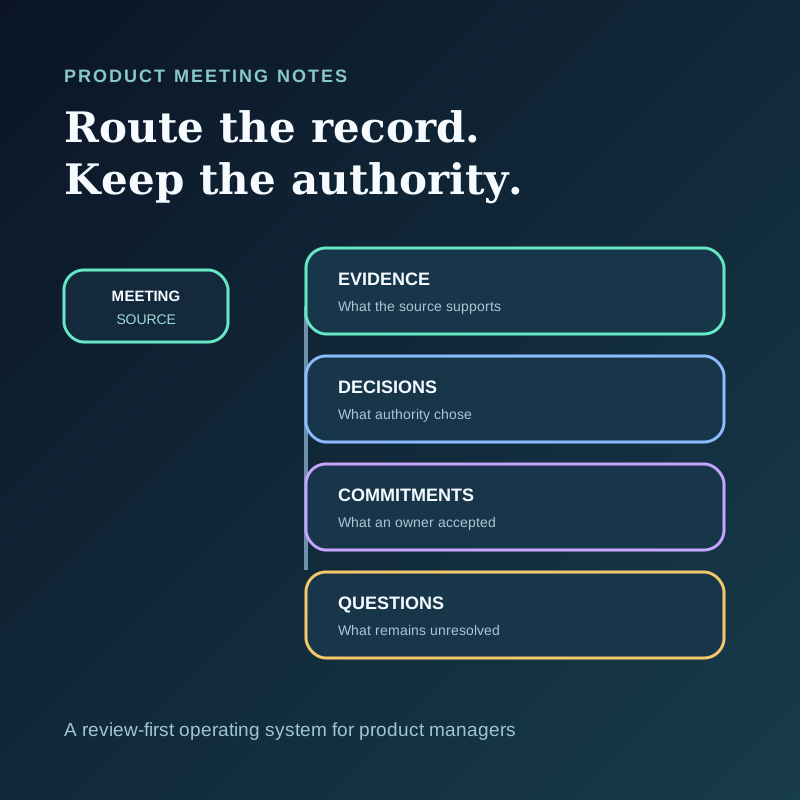
The best AI meeting-notes workflow for a product manager is not one universal summary. It is a routing system for four different records: evidence, decisions, commitments, and unresolved questions.
Use this path:
capture the source → classify the statement → verify the state → route the record → review the consequence
A customer quote belongs in an evidence record. An option discussed in a design review is not yet a decision. A task mentioned in Sprint Planning is not selected work until the accountable people confirm it. A stakeholder request is not a roadmap commitment.
This guide provides a meeting-type matrix, a copyable product record, a bounded AI prompt, and a weekly quality check. It is for product managers who want to spend less time reconstructing conversations without letting generated notes quietly become product authority.
Why product meeting notes fail
Product work moves through meetings with different purposes:
- a discovery interview produces observations, not feature votes;
- a design review produces critique and possible directions, not automatic approval;
- Sprint Planning produces a team-reviewed plan, not every item mentioned;
- a stakeholder review produces constraints and requests, not a unilateral roadmap;
- a delivery check produces status evidence, not proof that the customer problem is solved.
The remedy is to separate the meeting record from the product record. Meeting notes preserve what happened in one conversation. Product records carry only reviewed evidence, decisions, commitments, and open questions across conversations.
The distinction matches established product practice. GOV.UK's user-research planning guidance tells teams to define research questions, involve the team in analysis, and agree how findings feed planning, prioritization, and design decisions. Its roadmap guidance says teams should use performance analysis and user research to inform collaborative roadmap decisions. Atlassian's decision documentation template separately records decision status, roles, context, options, actions, and outcome.
None of those sources says that a transcript should become a roadmap automatically. The human decision layer is the point.
Route each meeting to the right product record
Use this matrix before writing a prompt or enabling automation.
| Meeting type | Useful draft | Human-owned decision | Do not infer |
|---|---|---|---|
| Customer or user interview | Source-linked observations and open questions | Whether evidence supports a finding or further research | Feature priority, market size, or a representative user need |
| Design review | Feedback tied to the right artifact and state | Accepted, rejected, deferred, or exploratory changes | Approval from repetition, enthusiasm, or seniority |
| Sprint or cycle planning | Proposed goal, candidate work, dependencies, and unresolved constraints | Goal, selected work, estimates, ownership, and plan | That discussion equals selection or assignment |
| Stakeholder review | Requests, constraints, options, and decision questions | Scope, priority, trade-off, or escalation | A roadmap promise or delivery date |
| Delivery or launch review | Current evidence, risks, readiness questions, and owners | Go, no-go, phased release, or another controlled action | Readiness from confidence or lack of objections |
| Customer escalation | Requests, proposed remedies, approved promises, and next update | What the authorized owner can commit and communicate | Fix scope, deadline, or account outcome |
For deeper workflows, use the focused guides for user-interview synthesis, visual design reviews, Sprint Planning, and customer commitments. This page owns the cross-meeting routing system rather than repeating those methods.
Build the four-record system
1. Evidence record
Use an evidence record when a meeting reveals something about a user, workflow, system, market, or delivery constraint.
| Field | Record |
|---|---|
| Source | Meeting, date, authorized transcript timestamp, note line, or artifact |
| Statement | Faithful excerpt or labeled paraphrase |
| Context | Participant type, workflow, task, artifact, or system state |
| Observation | What the source directly supports |
| Interpretation | What the team thinks it may mean |
| Coverage limit | Who, what, or which condition is not represented |
| Next evidence | Research, metric, test, or technical check needed |
Do not convert one interview into frequency, one complaint into a segment, or one stakeholder's preference into a user need. Preserve contradictions as separate evidence.
2. Decision record
Use a decision record when an accountable person or group chooses among options. Keep it separate from the discussion summary.
| Field | Record |
|---|---|
| Decision question | The exact choice to make |
| State | Proposed, decided, deferred, revisited, or superseded |
| Options considered | Real alternatives discussed or reviewed |
| Evidence | Links to authorized evidence records and constraints |
| Decision and rationale | The chosen direction and why |
| Authority | Who was permitted to decide |
| Scope | Product area, users, environment, exclusions |
| Review trigger | Date, new evidence, metric, incident, or dependency |
The companion AI meeting decision-log template shows how to maintain this record across multiple meetings.
3. Commitment record
Use a commitment record only after a real person or team accepts work.
| Field | Record |
|---|---|
| Action | Verb plus bounded deliverable |
| Owner | Person or team that explicitly accepted it |
| Due or review date | Stated date, or not set |
| Destination | Tracker, document, experiment, or approved system of record |
| Dependency | What must be true first |
| Definition of done | How the owner and reviewer know it is complete |
| Source | The accepted statement or reviewed plan |
If no owner or date was stated, leave it unresolved. A complete-looking task invented by AI is less useful than an honest missing field.
4. Unresolved-question record
Questions deserve their own queue because many product meetings exist to reveal uncertainty.
Record the question, why it matters, the missing evidence, who can answer it, and the next review point. Do not bury it under “other notes.” An unresolved legal, technical, accessibility, privacy, or customer question can invalidate an otherwise polished product plan.
A worked example: onboarding confusion
Imagine four meetings about workspace onboarding:
1. Two interview participants cannot tell whether a setup step succeeded. 2. A design review proposes adding a completion state. 3. Engineering says the current API cannot distinguish partial from complete setup. 4. Sprint Planning selects an instrumentation task but defers the UI change.
A weak weekly summary says: “Users need a clearer completion state, so the team will ship a new success screen this Sprint.”
The four records say something different:
| Record | Reviewed entry |
|---|---|
| Evidence | Two observed participants were uncertain in the tested workflow; coverage is limited to those sessions |
| Decision | No UI decision yet; the team needs a reliable completion signal first |
| Commitment | Engineering accepted an instrumentation task; UI work was not selected |
| Unresolved question | Which system event proves setup is complete across supported paths? |
The result is smaller, but it is actionable and honest. It also stops the next meeting from reopening the wrong question.
Copyable prompt for a draft product record
Use this only with meeting content and destinations your organization has approved:
Prepare a DRAFT product record from the supplied meeting context. Separate evidence, decisions, commitments, and unresolved questions. For every material row, include a recoverable source reference and the speaker label exactly as provided. Do not verify a person's identity from a speaker label. Do not infer user frequency, market size, priority, approval, roadmap placement, owner, deadline, estimate, or completion. Mark a decision as decided only when the authorized decision and scope are explicit. Mark an action as committed only when an owner accepted it. Preserve contradictory evidence and label missing fields NEEDS REVIEW. Return four sections: evidence records, decision records, commitment records, and unresolved questions. Label the full output DRAFT FOR PRODUCT REVIEW.
Review the source, then route only confirmed rows. A Markdown file is not automatically a roadmap update, backlog item, or message to stakeholders.
Where Shadow fits
Shadow is an AI interface for Mac that sees, hears, and runs. Its current Help documentation describes local meeting capture, transcription, speaker diarization, meeting Markdown, and available media in the local vault.
The meeting review brings recording, transcript, notes, screenshots, Skills, and Ask into one record. A detected Speaker is a meeting-local voice group, not a verified identity. When Smart Screenshots is enabled and a capture target is available, Shadow can save meaningful screen changes locally during Listening. Those screenshots do not prove which artifact, version, or decision a person meant.
A configured Meeting Skill can draft a structured result. Supported Skills can write Markdown or send a result to a webhook you control. The Help guide requires review of generated claims, decisions, owners, and dates before sharing. A webhook transmits a result; it does not approve a roadmap change or verify the destination record.
Review privacy and data leaving your Mac before using AI, sharing, or webhooks. Core capture is local, while optional AI and external destinations can send relevant context outside the Mac. Get the required recording consent before Listening begins; bot-free capture does not remove that obligation.
What is real, what is interpretation, and what is unproven
Real now
- Product teams use distinct research, decision, planning, and roadmap practices rather than treating all notes as one artifact.
- GOV.UK guidance connects research findings to collaborative prioritization and roadmap decisions.
- Atlassian publishes separate meeting-note and decision-documentation structures.
- Shadow currently supports local meeting capture and review plus optional, reviewable Skill outputs under documented data boundaries.
Interpretation
- The four-record system and routing matrix are this article's proposed operating model.
- Separating evidence, decisions, commitments, and unresolved questions can make review errors easier to locate.
- The system is useful only if the team preserves authority and source boundaries.
Unproven
- This article does not claim Shadow automatically builds or maintains these four records.
- It does not claim AI improves roadmap quality, delivery speed, product outcomes, or team alignment.
- It does not claim a generated note is accurate, approved, representative, or safe to publish without review.
Measure record quality, not note volume
Review the first five product packets manually.
| Check | Pass condition |
|---|---|
| Source recovery | A reviewer can find each material source quickly |
| State precision | Evidence, decisions, commitments, and questions remain distinct |
| Authority integrity | Only authorized people are recorded as decision owners |
| Commitment integrity | No discussed task becomes accepted work without confirmation |
| Contradiction retention | Competing evidence remains visible |
| Route accuracy | Confirmed rows reach the correct system; unresolved rows do not |
Count corrections by field. If decision state repeatedly needs repair, tighten the template before adding more automation.
If this review boundary fits your product workflow, download Shadow and test it on one authorized meeting. Start with a draft record and keep the product decision with the person or team that owns it.
Sources and verification date
This article was researched and verified on October 5, 2026.