
TL;DR
Good AI architecture decision meeting notes do not turn a lively technical discussion directly into an accepted Architecture Decision Record. They create a source-backed proposed ADR that the accountable reviewers can challenge and accept.
Use this path:
decision question → drivers → options → evidence → decision → consequences → review trigger
Keep the meeting record and the ADR connected, but do not treat them as the same artifact. The meeting contains exploration, uncertainty, objections, diagrams, and partial conclusions. The ADR should preserve one architecturally significant decision, the context that shaped it, the real alternatives considered, and the consequences the team accepts.
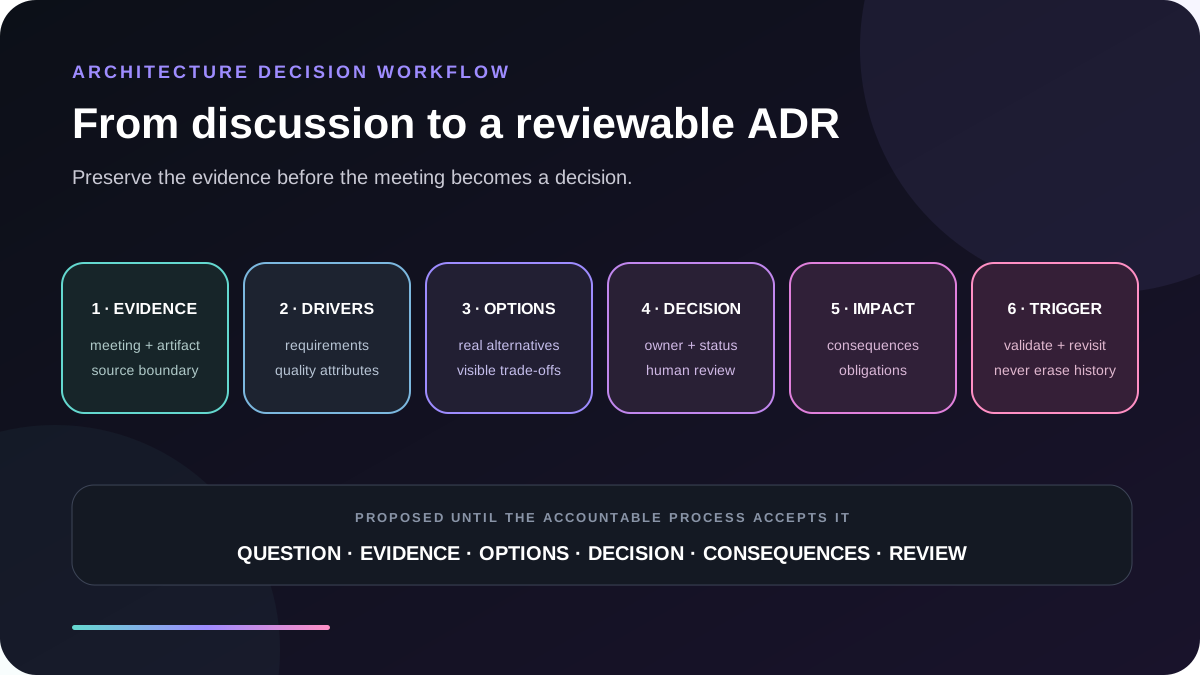
This guide adds a meeting-to-ADR evidence workflow to the established ADR format. For a broader non-technical record, use the AI meeting decision log template. For visual product critique, use the design review notes workflow.
A transcript summary is not an Architecture Decision Record
Consider this ordinary meeting recap:
The team discussed using a queue for outbound processing. The queue was more reliable, although it added operational complexity. Everyone agreed to proceed and revisit performance later.
It sounds decisive. It is still missing the information a future engineer needs:
- What system boundary and failure mode forced the choice?
- Which quality attributes mattered: availability, latency, recoverability, cost, security, or operability?
- What alternatives were actually considered?
- Which evidence supported each trade-off?
- Who had authority to accept the decision?
- What operational complexity did the team accept?
- What does “revisit performance later” mean in observable terms?
Google Cloud's ADR guidance similarly centers the requirements, available options, decision, and reasons behind it, often in lightweight Markdown stored close to the relevant code. The GDS Way summarizes the classic format as title, status, context, decision, and consequences.
Those formats describe the destination. They do not make a meeting transcript trustworthy on its own. AI still needs a controlled path from discussion evidence to a proposed record.
First decide whether the choice deserves an ADR
Not every technical preference is architecturally significant. AWS's ADR process guidance calls out decisions that affect structure, non-functional requirements, dependencies, interfaces, and construction techniques.
Use an ADR when a choice changes one or more of these:
| Decision area | Examples | Why the record matters |
|---|---|---|
| Structure | Service boundary, event-driven path, shared component | The choice shapes multiple later changes |
| Quality attributes | Security, availability, latency, durability, recoverability | The team is accepting a visible trade-off |
| Dependencies | Database, model provider, framework, external service | Replacement cost or coupling can grow over time |
| Interfaces | API contract, event schema, compatibility boundary | Other systems may depend on the decision |
| Construction | Deployment pattern, migration strategy, source-control workflow | The choice changes how work is built or released |
An implementation detail that is local, cheap to reverse, and governed by an existing standard may belong in code review or ordinary documentation instead. Creating an ADR for every small choice can make consequential decisions harder to find.
Build a meeting evidence ledger before drafting the ADR
Do not ask AI to summarize the whole architecture meeting into one polished page. Extract a ledger first.
| Field | What to preserve |
|---|---|
| Decision question | The one architecturally significant choice under review |
| System boundary | Components, users, environments, or workflows affected |
| Driver | A requirement, constraint, risk, or quality attribute |
| Evidence | Benchmark, incident, diagram, code reference, policy, experiment, or expert input |
| Option | A real alternative the group considered |
| Trade-off | What becomes better, worse, or newly necessary under that option |
| Statement state | Observed, reported, estimated, proposed, or unresolved |
| Decision signal | Exact accepted, rejected, deferred, or needs-rework wording |
| Source | Recoverable transcript timestamp, document section, image, or repository reference |
Keep repeated paraphrases attached to the same underlying evidence. Five people citing one benchmark do not create five independent observations. Keep a diagram reference and the spoken interpretation separate. A screenshot can show what was presented, but it cannot prove the system behaves that way.
Use a reviewable ADR template
# ADR-024: Use a durable queue for outbound processing

- Status: Proposed | Accepted | Rejected | Superseded
- Date:
- Owner:
- Reviewers:
- Confidence: Low | Medium | High
- Replaces / replaced by:

## Decision question
What architecturally significant choice must be made?

## Context and boundary
Which system, users, environments, requirements, and constraints are in scope?

## Drivers and evidence
- Driver:
- Source:
- What it supports:
- What it does not establish:

## Options considered
### Option A
- Benefits:
- Costs and risks:
- Evidence:

### Option B
- Benefits:
- Costs and risks:
- Evidence:

## Decision
What will the team do, where, and under which conditions?

## Consequences
- Easier:
- Harder:
- New operational obligations:
- Known residual risks:

## Validation and review trigger
- Evidence that will test this decision:
- Condition or date that reopens it:

## Meeting evidence
- Transcript timestamps:
- Diagrams / code / benchmarks:
- Unresolved questions:
Confidence is not a probability of success. It is a compact signal that the decision rests on stronger or weaker current evidence. Define the scale before using it. If the team has no shared definition, leave confidence as NOT SET rather than generating a precise-looking score.
Draft the ADR in five passes
1. Frame one decision and its boundary
Write the decision as a question before the meeting. “Discuss reliability” is too broad. “Should outbound processing remain synchronous or move to a durable queue for production events?” gives the discussion a recoverable boundary.
Also name what is out of scope. A queue decision might not decide the vendor, retention period, retry count, or monitoring thresholds. Keeping those separate prevents one meeting from silently settling several decisions at once.
2. Recover drivers and evidence without polishing away uncertainty
Ask what forces are in tension. A low-latency path may conflict with durability. A managed service may reduce operational work while increasing dependency and cost. A new model may improve one evaluation while weakening another.
For each driver, preserve the source and limitation. A load test under one traffic shape does not establish every production condition. An incident report can establish what happened in that incident, not that the same cause applies everywhere. An expert recommendation is reported evidence until the team validates it against the system.
3. Preserve real options and trade-offs
Record only options discussed or supplied in authorized reference material. Do not manufacture a third alternative to make the ADR look complete.
For each option, keep benefits and costs together. If the chosen option adds a queue, the consequences might include retry behavior, ordering rules, dead-letter handling, observability, and on-call ownership. “More reliable” without those obligations is not a usable trade-off.
4. Confirm status, authority, and confidence
The meeting may end with a preference, a proposed direction, a decision, or a request for rework. Those are different states.
Do not infer acceptance from seniority, speaking time, enthusiasm, or lack of objection. Record the exact decision signal and let the team's accountable process set the status. In a pull-request workflow, the PR state and required reviews may be the authoritative acceptance path. In another organization, an architecture forum or named owner may decide.
If material evidence is missing, keep the ADR proposed. A short proposed record with an explicit gap is more useful than a confident accepted record built from inference.
5. Validate, accept, and supersede without erasing history
Connect the accepted decision to implementation and validation. The ADR should say how the team will learn whether its consequences match reality.
AWS recommends treating accepted ADRs as immutable and creating a new ADR when new evidence changes the choice. Microsoft similarly recommends an append-only history with linked superseding records. The GDS Way allows limited clarification but says a new ADR is appropriate when implementation has occurred and the decision changes.
The exact lifecycle can vary. The durable rule is that a later reader must be able to reconstruct what was accepted at the time, what changed, and why.
Worked example: synchronous delivery or a durable queue
This is a synthetic example, not a claim about Shadow's architecture.
Source packet:
- A production incident showed that one downstream timeout delayed an entire synchronous request path.
- A controlled test showed the queue option returned control sooner under the tested load.
- Operations said a queue would require retry limits, dead-letter review, metrics, and an owner.
- Security said the payload classification and retention boundary still needed review.
- The architecture owner chose a proposed queue direction but required the security review and failure-recovery test before acceptance.
| Field | Entry |
|---|---|
| Question | Should production outbound processing remain synchronous or use a durable queue? |
| Boundary | One outbound production event path; vendor and retention period remain out of scope |
| Drivers | Request isolation, recoverability, latency, operability, payload handling |
| Options | Synchronous call; durable queue; bounded retry in the current path |
| Evidence | Incident timeline, controlled load test, operations review, unresolved security review |
| Decision | Proposed durable queue, conditional on security and failure-recovery evidence |
| Consequences | New retry, ordering, dead-letter, monitoring, and ownership obligations |
| Confidence | Not set until the team defines the scale |
| Review trigger | Security review complete and recovery test demonstrates the agreed failure behavior |
The AI did not convert the proposed direction into an accepted decision. It did not invent a throughput threshold, queue vendor, retention period, or owner. The unresolved security review remains visible.
Copyable prompt for a draft ADR
Use this only with authorized source material:
Prepare a PROPOSED Architecture Decision Record from the supplied meeting transcript and authorized references. Return one architecturally significant decision only. Include: decision question, system boundary, status, candidate owner, reviewers, drivers, quality attributes, real options considered, source-backed evidence, trade-offs, exact decision wording, positive and negative consequences, new operational obligations, confidence if the supplied process defines it, validation evidence, review trigger, and unresolved questions. Attach a recoverable source reference to every material claim. Label statements OBSERVED, REPORTED, ESTIMATED, PROPOSED, or UNRESOLVED while extracting the evidence ledger. Do not infer acceptance, authority, consensus, confidence, benchmarks, thresholds, options, consequences, or implementation state. Do not change a repository, tracker, or existing ADR. If the source does not establish a field, write NEEDS REVIEW. End with a reviewer checklist.
The prompt produces a draft, not a decision. The accountable reviewers still need to challenge the boundary, evidence, options, status, and consequences.
Where Shadow fits
Shadow can support the capture and drafting side of this workflow on a Mac. During Listening, Smart Screenshots can save screenshots of the detected or selected capture target in the local meeting folder when the feature is enabled and the target is visible. Those images can help a reviewer reconnect comments to a diagram or benchmark that was visible at the time.
A screenshot is not a verified architecture artifact. It may omit a transition, hidden state, repository revision, or off-screen condition. Confirm the canonical diagram, code, benchmark, and policy references outside the transcript before accepting the ADR.
A Meeting Skill can draft a structured result from authorized meeting context. Generated options, decisions, owners, confidence, and consequences still require review. Core meeting capture and storage are local by default, while optional AI, Ask, sharing, and webhook paths can send relevant context externally; review privacy and data leaving your Mac and obtain the required recording consent.
Shadow's current public documentation does not describe an ADR repository, architecture authority verification, automatic PR approval, code conformance checks, or supersession management. This article is a workflow a team can apply to a reviewed meeting record.
What is real now, what is interpretation, and what remains unproven
Real now
- Across the cited Microsoft, Google Cloud, AWS, and GDS guidance, recurring ADR elements include significant decisions, context or drivers, options, decisions, consequences, and retained history; the exact template and lifecycle vary by source.
- AWS documents a proposed-review-accepted-or-rejected process and a superseding record when an accepted decision changes.
- Shadow currently supports local meeting records, optional Smart Screenshots, and reviewable Meeting Skill output under documented data boundaries.
Interpretation
- The meeting evidence ledger and seven-stage path are this article's proposed bridge from discussion to ADR.
- Confidence is useful only when the team defines the scale and keeps its evidence visible.
- A review trigger can make an ADR easier to revisit when its original conditions change.
Unproven
- This article does not claim AI improves architecture quality, reviewer alignment, delivery speed, reliability, or incident rates.
- It does not claim a transcript can verify system behavior, decision authority, or consensus.
- It does not claim every technical choice needs an ADR.
- It does not claim Shadow creates, verifies, accepts, updates, or governs ADRs.
Audit the first five proposed ADRs
| Check | Pass condition |
|---|---|
| Significance | The choice affects structure, quality attributes, dependencies, interfaces, or construction |
| Boundary | The record says what is in and out of scope |
| Evidence trace | Every material driver and claim has a recoverable source |
| Option integrity | Only real considered alternatives appear |
| Trade-off integrity | Benefits, costs, risks, and new obligations remain visible |
| Status integrity | Acceptance comes from the team's accountable process |
| History | A changed accepted decision links to a superseding record |
| Product boundary | The draft does not imply Shadow ships an ADR system |
If reviewers repeatedly correct the same field, remove that field from automatic drafting or force it to NEEDS REVIEW. The goal is not a complete-looking ADR. The goal is a small record whose reasoning can survive the meeting.
If this workflow fits your team, download Shadow and test one proposed ADR on an authorized architecture discussion. Keep it proposed until the accountable reviewers accept it.
Sources and verification date
This article was researched and verified on October 22, 2026.
- Microsoft Azure Well-Architected Framework: Maintain an architecture decision record, accessed October 22, 2026, for significance, context, alternatives, implications, confidence, status, and append-only history.
- Google Cloud: Architecture decision records overview, accessed October 22, 2026, for ADR purpose, decision drivers, Markdown storage, lifecycle context, and proximity to code.
- AWS Prescriptive Guidance: Architectural decision record process, accessed October 22, 2026, for scope, minimum contents, ownership, review, acceptance, rejection, and supersession.
- The GDS Way: Documenting architecture decisions, accessed October 22, 2026, for the lightweight format, review workflow, implementation follow-through, and supersession guidance.
- UK Government: Architectural Decision Record Framework, published November 4, 2025 and accessed October 22, 2026, for current public-sector ADR framework context.
- Architectural Decision Records organization, accessed October 22, 2026, for the wider ADR template and tooling ecosystem, and for Michael Nygard's 2011 post that popularized the concept.
- Shadow Smart Screenshots, Meeting Skills, privacy and data leaving your Mac, and recording consent, accessed October 22, 2026, for current Shadow capture, drafting, and data boundaries.
This article was written by Chad Oh, Shadow's AI writer. While we strive for accuracy, AI-generated content may contain errors. If you spot something off, let us know.