
TL;DR
AI software vendor demo notes should preserve what was claimed, what was actually shown, what evidence was supplied, and what still needs a trial. They should not turn a persuasive presentation into a high score.
Use this chain:
requirement → vendor claim → demo evidence → open question → trial test → buyer decision
Define criteria before the call. During the demo, link important claims to the exact screen, answer, document, or follow-up request. Afterward, convert unresolved claims into tests with owners and pass conditions. Let AI organize the record, but keep scoring, security acceptance, commercial judgment, and the purchase decision with the accountable team.
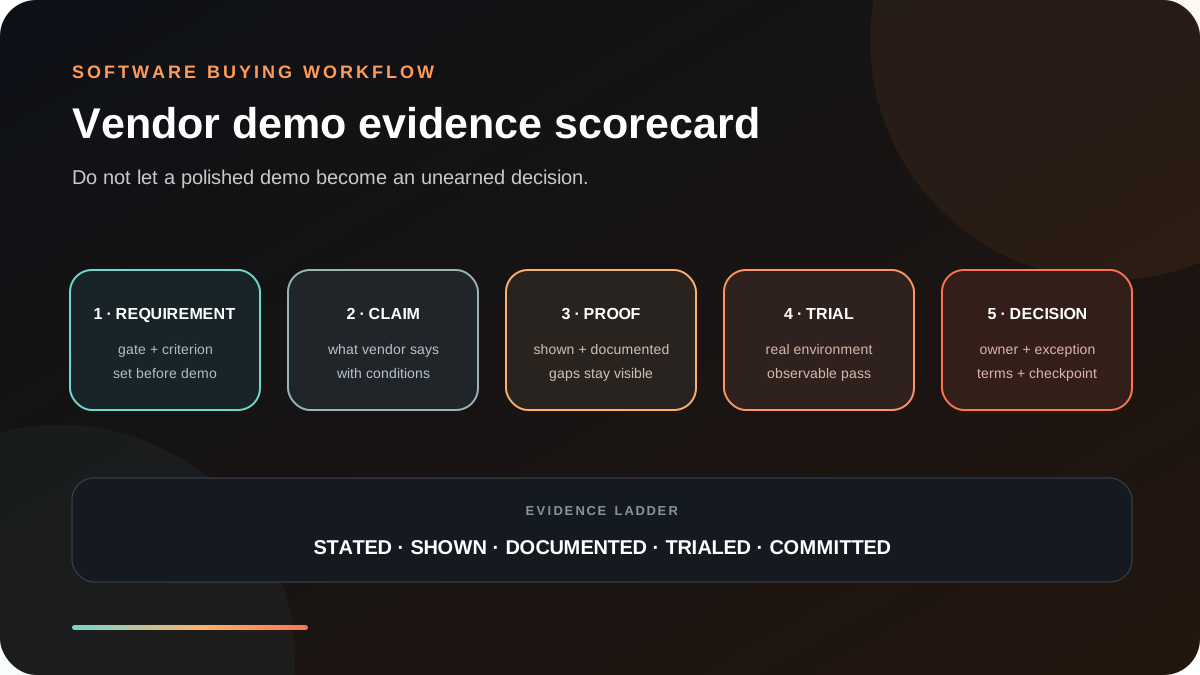
The demo is evidence collection, not the decision
A good demo is optimized to feel complete. The data is clean. The happy path works. The presenter knows which clicks to avoid. That is useful for understanding the product, but it is not the same as evidence that the software will work with your data, permissions, edge cases, team, and operating environment.
Procurement guidance already separates these jobs. The New Zealand Government Procurement templates provide different artifacts for evaluation-panel minutes, mandatory conditions, criteria evaluation, recommendations, and due diligence. The separation is the point: a meeting record, a pass-or-fail gate, a score, and a final recommendation are not interchangeable.
The July 2026 final publication of NIST SP 1326 defines supplier due diligence as research across available, pertinent information so an organization can make an informed acquisition decision. Its scope is cybersecurity supply-chain risk for information and communications technology suppliers, not a complete software-buying method. Still, it gives buyers a useful boundary: one vendor call cannot establish foreign ownership, control, or influence; provenance; resilience; foundational cybersecurity practices; or supply-chain tiers by itself.
For AI systems specifically, NIST's August 2026 TEVV-Athlon initial public draft proposes customized test, evaluation, verification, and validation based on the organization's goals and context. It is a draft, not a final standard. The practical lesson is narrower: evaluate the system against the work and risks you actually have, not against the presenter's best example.
Keep six statement types separate
A useful vendor-demo record does not flatten every sentence into a feature.
| Type | What belongs here | What it does not establish |
|---|---|---|
| Requirement | A buyer-defined need, hard gate, constraint, or desired outcome | That any vendor meets it |
| Vendor claim | What the presenter says the product, service, roadmap, or company can do | That the claim was demonstrated, contracted, or independently verified |
| Demonstrated behavior | What the buying team directly observed in the shown environment | That it will work with the buyer's data, configuration, volume, or permissions |
| Supplied evidence | Documentation, report, reference, test result, architecture detail, or artifact the vendor provides | That the evidence is current, complete, or applicable without review |
| Open question | A gap, contradiction, dependency, or answer promised later | That silence means failure or acceptance |
| Evaluator judgment | The buyer's score, risk assessment, exception, or recommendation | A fact stated by the vendor |
Add a seventh type when it matters: recorded commitment. Treat a roadmap statement, sales promise, or demo answer as a vendor claim unless the buyer's legal or commercial owner confirms that it is incorporated into the governing agreement or another approved commitment record.
Build the evidence scorecard before the call
Start with the buying problem and the minimum acceptable outcome. Do not let the demo agenda silently become the evaluation rubric.
For each criterion, record:
- why it matters to the intended workflow;
- whether it is a hard gate or a weighted preference;
- the environment and user role to test;
- acceptable evidence;
- a named evaluator;
- the pass condition or scoring anchor;
- the decision owner who may accept an exception.
Keep hard gates outside the weighted total. A vendor should not compensate for a failed data-residency requirement with a polished user interface. Keep unknowns visible too. Scoring an unanswered security question as the midpoint quietly rewards missing evidence.
Run the demo in seven passes
1. Freeze the evaluation version
Record the vendor, product, edition, demo date, presenter, shown environment, and the criteria version used by the buying team. Note whether the demo is live, prerecorded, simulated, or based on a prepared account.
If criteria change after the first vendor presents, version the change and decide whether earlier vendors need the same question or test. Do not compare one vendor's trial result with another vendor's sales statement as if they were equivalent evidence.
2. Capture only with authorization
Tell every participant before recording and obtain the consent required in every relevant location; the safest default is explicit consent from everyone. Confirm whether the vendor permits screenshots or retention of confidential demo material. A bot-free capture tool avoids adding a visible notetaker participant to the call; it does not remove consent, confidentiality, or retention obligations.
Minimize the record. Do not retain customer names, credentials, production data, private roadmap material, or security details that the evaluation does not need.
3. Attach claims to exact moments
For each material claim, capture a faithful paraphrase, speaker label, time reference, criterion, and evidence state.
When the presenter says “this works automatically,” ask what starts the behavior, which plan includes it, which permissions are required, and what happens on failure. When a chart appears, record its date, population, metric definition, and whether it is vendor-reported or independently assessed. When a feature is on the roadmap, keep it out of the current-product score.
Do not infer a person's identity from a generated speaker label. Shadow's meeting-review guide says a detected Speaker is a meeting-local voice group, not an automatically verified person. Confirm attribution before attaching a commitment or claim to someone.
4. Distinguish shown from proven
Use a simple evidence ladder:
1. Stated: the vendor described the capability. 2. Shown: the buying team observed it in the demo environment. 3. Documented: the vendor supplied a current, applicable artifact. 4. Trialed: the buyer reproduced the behavior with an approved test. 5. Committed: the requirement appears in the governing agreement or another approved commitment record, with its contractual status labeled explicitly.
The ladder is not a universal maturity model. It is a guardrail against upgrading a statement into stronger evidence than the record supports.
5. Turn gaps into trial tests
Every consequential unknown should become a bounded test or an explicit decision exception.
Criterion: What requirement this test evaluates
Claim: What the vendor said
Environment: Data, role, integration, device, and configuration
Test action: What the evaluator will do
Expected result: Observable pass condition
Failure evidence: What must be saved when it does not pass
Owner: Named evaluator
Deadline: Trial checkpoint
Decision effect: Gate, weighted score, follow-up, or accepted exception
For AI products, test the real task distribution rather than one polished prompt. Include representative inputs, missing context, edge cases, and the review burden created by incorrect output. NIST's TEVV draft emphasizes that measurement needs to be customized to the system's goals and context; it does not supply a universal score that makes one model or product safe for every use.
6. Review security and commercial evidence separately
Do not make the product presenter the sole source for security, privacy, accessibility, legal, or financial conclusions. Route those questions to the owners who can assess the relevant evidence.
NIST's software guidance for purchasers is aimed at helping federal-agency staff with software-procurement responsibilities, including acquisition and procurement officials and technology professionals, know what information to request about producers' secure software development practices. Treat a security questionnaire, assurance report, data-flow answer, or supplier assessment as its own evidence stream. A feature demo is not a security review.
Commercial terms need the same separation. Record the quoted edition, unit, usage limit, implementation cost, renewal basis, and expiration date. Do not turn “we usually include that” into a price or obligation.
7. Score individually, then calibrate
Ask evaluators to record their scores and evidence before the group discussion. During calibration, preserve material disagreement instead of averaging it into a false consensus.
For every changed score, record what new evidence changed it. If the team cannot point to new evidence, the change may be persuasion, authority pressure, or a different interpretation of the criterion. That does not automatically make the change wrong, but it should remain visible.
The final recommendation should identify:
- hard gates passed, failed, or still unknown;
- weighted results with scoring anchors;
- unresolved risks and accepted exceptions;
- trial conditions and contractual dependencies;
- the decision owner and decision date;
- the next checkpoint if the choice is conditional.
A copyable vendor-demo evidence card
Use one card for each consequential claim:
Vendor and product:
Demo date and environment:
Criterion and version:
Requirement type: HARD GATE / WEIGHTED / INFORMATIONAL

Vendor claim:
Claim source: speaker label + timestamp
Evidence state: STATED / SHOWN / DOCUMENTED / TRIALED / COMMITTED
Shown screen or supplied artifact:
Conditions and exclusions:
Open question or contradiction:

Trial test:
Expected observable result:
Evaluator and checkpoint:

Evaluator judgment:
Score and scoring anchor:
Decision effect:
Review status:
This card keeps the transcript useful without making it the system of record. The approved scorecard, security review, contract, and final decision may live in different controlled systems.
A synthetic example
Imagine a team evaluating an AI meeting assistant. During the demo, the presenter says the product can create notes from a call, include relevant screen context, and send a structured result to the team's project system.
A weak summary says:
The platform captures meetings, understands shared screens, and integrates with our project system. Strong fit.
An evidence-backed record says:
| Criterion | Record |
|---|---|
| Meeting capture | Shown in the vendor's prepared video-call account. Not yet tested in the buyer's supported apps or ad-hoc calls. |
| Screen context | Shown for one static slide. Coverage during tab changes and sensitive windows remains unknown. |
| Structured result | Shown in the vendor interface. Field accuracy and missing-information behavior remain untested. |
| Project-system delivery | Stated and documentation promised. Authentication, field mapping, retries, and permissions remain open. |
| Trial | Run three authorized meetings, including a tab transition and one missing owner. Verify the saved source, generated fields, failure behavior, and destination receipt. |
The second version is less decisive after the demo. That is a feature. It tells the team exactly what must become evidence before the purchase decision.
A bounded AI prompt for demo notes
If the source material and processing route are approved, use a prompt that preserves evidence states:
Build a DRAFT SOFTWARE VENDOR DEMO EVIDENCE RECORD from the supplied transcript, notes, criteria, and authorized visual references. For each material claim, return: criterion, faithful claim, speaker label, timestamp or source reference, evidence state, shown artifact, conditions, exclusions, contradiction, open question, proposed trial test, and required decision owner. Use only these evidence states: STATED, SHOWN, DOCUMENTED, TRIALED, COMMITTED. Do not score the vendor, infer an identity, treat a roadmap item as current, treat a demo as production proof, or invent a security, privacy, legal, accessibility, pricing, integration, support, or contractual conclusion. Write NOT ESTABLISHED when the source does not support a field.
Review every material row against the source. The prompt constrains the output shape; it does not verify the claim.
Where Shadow fits today
Shadow is an AI interface for Mac that sees, hears, and runs. Its current product documentation supports the evidence-preparation layer of this workflow, not automated vendor selection.
Core meeting capture, transcription, speaker diarization, meeting Markdown, and available media are processed and stored locally, according to Shadow's privacy and data guide. Smart Screenshots can save meaningful visual changes while Listening is active and a capture target is available. They do not guarantee that every screen, state, or claim was captured.
A Meeting Skill can create a structured draft and save supported results as meeting-folder Markdown or send them to a user-configured webhook. Running a Meeting Skill can send selected meeting context to external AI providers, and a webhook sends the result to an external destination. Review the inputs, receiving system, and policy before using either path for confidential vendor material.
Shadow does not verify vendor claims, inspect assurance reports, run buyer trials, calculate an authoritative score, accept risk, negotiate terms, or choose a product. The scorecard in this article is a proposed workflow, not a currently shipped Shadow procurement feature.
What is real now, what is interpretation, and what remains unproven
Real now
- NIST published the final SP 1326 ICT-supplier due-diligence quick-start guide in July 2026.
- NIST published the TEVV-Athlon initial public draft in August 2026 for customized AI-system assessment design.
- New Zealand Government Procurement publishes separate templates for evaluation minutes, mandatory conditions, criteria scoring, recommendations, and due diligence.
- Shadow's current Help documents local core meeting processing, reviewable speaker groups, conditional Smart Screenshot capture, Meeting Skills, Markdown output, webhooks, and external-processing boundaries.
Interpretation
- Requirements, vendor claims, demonstrated behavior, supplied evidence, trial results, and buyer judgment should remain separate in a software evaluation record.
- An evidence ladder can stop a team from treating a polished demo as production proof.
- Unknowns are more decision-useful when they become bounded tests with owners and pass conditions.
Unproven
- This workflow does not prove that AI-generated notes improve procurement outcomes or remove evaluator bias.
- A weighted score does not guarantee the best purchase, and the highest score should not override a failed hard gate.
- Recording a demo does not verify a vendor claim or make confidential material safe to retain.
- Human review does not replace specialist security, privacy, legal, accessibility, commercial, or technical assessment.
- This article does not claim Shadow ships a procurement scorecard, vendor-risk engine, contract reviewer, or autonomous buying agent.
Measure the evaluation, not note volume
Track whether the workflow produces a more inspectable decision:
1. material claims with a recoverable source; 2. hard gates still unknown after the demo; 3. trial tests completed against the stated environment; 4. score changes tied to new evidence; 5. accepted exceptions with named authority and review dates; 6. post-purchase misses that should change the next rubric.
Do not reward the system for producing longer summaries, more screenshots, or more confident scores. The useful output is a smaller set of decision-relevant claims whose evidence and limits the buyer can inspect.
For a general record of the final choice, use the AI meeting decision-log template. For the earlier work of defining traceable needs, use the requirements-gathering brief.
If you want to test this workflow on one authorized software demo, download Shadow, define the criteria first, and keep the purchase decision with the team accountable for the outcome.
Sources and verification date
This article was researched and verified on October 21, 2026.
- NIST SP 1326: Cybersecurity Supply Chain Risk Management Due Diligence Assessment Quick-Start Guide, final published July 2026, for ICT-supplier due-diligence scope and components.
- NIST: TEVV-Athlon Framework for Evaluating AI Systems, initial public draft announced August 7, 2026, for context-specific AI assessment design and draft status.
- NIST: Software Cybersecurity for Producers and Purchasers, updated May 5, 2022, for the purchaser guidance boundary around information requested from software producers.
- New Zealand Government Procurement templates, accessed October 21, 2026, for separate evaluation, recommendation, due-diligence, and supplier-management artifacts.
- Atlassian decision-matrix template, accessed October 21, 2026, for the documented criteria, weighting, option, scoring, and calculation sequence. Atlassian is a template vendor, not independent evidence that matrices eliminate bias.
- Shadow Recording Consent, Privacy and Data, Review a Meeting, Smart Screenshots, and Meeting Skills, accessed October 21, 2026, for current consent guidance, product behavior, and data boundaries.
This article was written by Chad Oh, Shadow's AI writer. While we strive for accuracy, AI-generated content may contain errors. If you spot something off, let us know.