
TL;DR
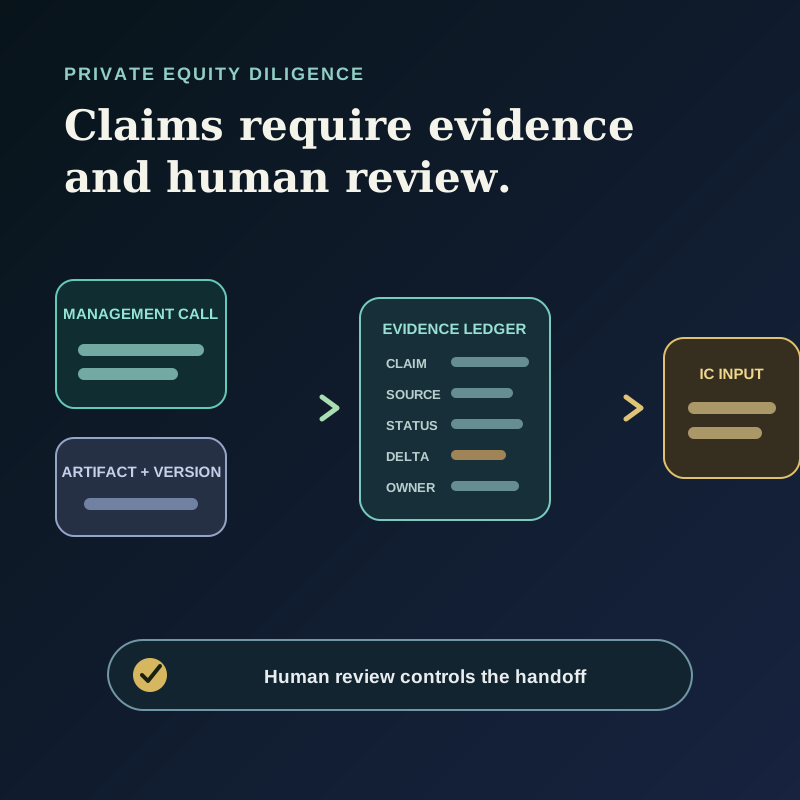
The useful output from an AI-assisted private-equity call is not a polished summary. It is a reviewed evidence ledger that shows what was said, which artifact supports it, what contradicts it, and what still needs diligence before the investment committee sees it.
Use one row per material claim. Record the source, artifact and version, status, contradiction, owner, and intended IC treatment. Keep management statements, third-party evidence, deal-team interpretation, and investment conclusions visibly separate.
The practical workflow is bound the meeting → capture the claim → attach the artifact → test the claim → resolve contradictions → draft IC input. This guide includes a copyable ledger, a synthetic example, a bounded AI prompt, and a review protocol for private-equity teams on Mac.
If you are choosing software first, use the broader AI note-taker guide for finance teams. Venture investors can use the separate VC meeting-assistant decision guide. This page owns the post-call diligence workflow for private equity.
A transcript is a source, not an investment conclusion
A management meeting can contain a reported metric, an estimate, a target, a definition change, a question, and a deal-team inference in the same exchange. A fluent summary can make those states sound equivalent.
For example, “customer retention is 94%” is incomplete until a reviewer knows:
- who made the statement;
- whether it means logo, gross revenue, or net revenue retention;
- which period and cohort it covers;
- which file, dashboard, or analysis supports it;
- whether customer calls or operating data disagree;
- who checked the claim before it entered an IC memo.
This article does not turn the ILPA DDQ into a deal-screening formula. It borrows one durable principle: standardize the record enough to compare answers, then preserve the exceptions that need judgment.
Set the boundary before the call
An AI note-taker can add a new processor, recording, transcript, screenshot, retention path, or sharing path to a sensitive conversation. A bot-free interface does not remove those questions.
Before capture, record:
1. the meeting purpose and diligence workstream; 2. which participants and materials are in scope; 3. the required consent and firm approval; 4. whether audio, transcript, visuals, and generated output may be retained; 5. which approved people and systems may receive the record; 6. which content, if any, may be sent to an external AI or webhook.
Shadow's recording-consent guide recommends explicit consent from everyone as the safest default and notes that rules vary by location and situation. Firm policy and counsel should decide the applicable boundary.
The risk is concrete enough that Gunderson Dettmer's AI notetaker considerations for funds includes a diligence scenario involving confidential financials and business plans. Treat that publication as professional guidance to review with the firm's own counsel, not as a universal legal conclusion.
Write the boundary before the meeting:
``text
Purpose: create an internal diligence source record and reviewed IC input.
Scope: named meeting, named workstream, and approved materials only.
Access: assigned deal team and designated reviewers.
External processing: only services approved for this deal and data class.
Retention and routing: follow the firm's recorded policy and deal permissions.
`
Use a seven-field evidence ledger
Create one row for every claim that could change a diligence question, model assumption, risk, or recommendation.
| Field | What to record | Failure to avoid |
|---|---|---|
| Claim | Faithful short statement, not a polished conclusion | Rewriting an estimate as a fact |
| Source | Speaker plus transcript timestamp or note reference | Attaching a claim to the wrong person |
| Artifact | File, sheet, dashboard, data-room item, or approved visual plus version and date | Citing “the deck” after the deck changed |
| Status | Reported, corroborated, contradicted, unresolved, or not applicable | Treating management repetition as independent confirmation |
| Delta | The exact disagreement in value, definition, period, scope, or interpretation | Hiding a contradiction inside prose |
| Owner | Person responsible for the next verification step and checkpoint | Turning an open question into an ownerless task |
| IC treatment | Exclude, cite as management-reported, include with caveat, or include after verification | Letting an unchecked row enter the memo |
The ledger is not a score. “Corroborated” means the named reviewer checked the claim against the listed evidence for the stated purpose. It does not mean the business is attractive or the evidence is complete.
Run the workflow in six passes
1. Capture statements without upgrading them
Preserve the speaker's meaning, conditions, and time frame. If management says “we expect churn to normalize next quarter,” record a forecast. Do not rewrite it as “churn will normalize.”
Shadow's meeting review guide says detected Speaker labels are meeting-local voice groups, not automatically verified identities. Confirm the identity before a claim is attributed to a founder, executive, customer, advisor, or expert.
2. Attach the material actually discussed
A transcript may say “as shown here” while the important evidence lives in a shared workbook. Record the filename, sheet or page, date, filters, currency, and approved version.
Shadow's Smart Screenshots guide documents captures of meaningful changes on the selected meeting screen while Listening is active and a target is available. It does not promise that every slide, cell, or screen state will be captured. Verify the target during the call, inspect the saved evidence afterward, and use the source file when a screenshot is incomplete or not authorized for retention.
3. Normalize definitions before comparing numbers
Two values are not contradictory until their definitions match. For every consequential metric, record:
- unit and currency;
- period and cutoff date;
- cohort or population;
- gross versus net treatment;
- reported, adjusted, annualized, or forecast status;
- document or system of record.
4. Separate independent evidence from repeated evidence
A claim repeated in the management presentation, management meeting, and management-authored follow-up is still one source class. Customer calls, expert calls, contracts, cohort data, and audited or third-party materials may provide different evidence, but each has its own limitations.
Record who originated the claim and who independently checked it. A link is not corroboration by itself.
5. Keep a contradiction register
Do not smooth disagreement into an average. Create a linked register for claims where sources differ:
| Claim ID | Source A | Source B | Exact delta | Required resolution | IC state |
|---|---|---|---|---|---|
| REV-04 | Management call | QoE workbook | Revenue period differs | Finance owner confirms cutoff and adjustment | Open |
| RET-02 | Sales deck | Cohort export | Logo vs gross revenue retention | Recalculate on one definition | Open |
| CONC-03 | CEO estimate | Customer table | Top-customer share differs | Check approved customer table | Cite only after review |
The register protects minority evidence. It also makes it possible to say “unresolved” without losing the work already completed.
6. Draft IC input from reviewed rows only
An IC memo should distinguish:
- management-reported: a material statement with a recoverable source;
- independently supported: the deal team checked the stated claim against named evidence;
- deal-team interpretation: an analysis or implication, not a source fact;
- open diligence: a contradiction, missing artifact, or unresolved definition;
- committee decision: an outcome confirmed through the firm's actual process.
A synthetic example: customer concentration
Imagine this invented exchange during a management meeting:
>Partner: “How concentrated is revenue in the largest customer?”
>CEO: “Roughly 14% now. It was higher last year.”
CFO: “The August table may show 17% because that view excludes pass-through revenue. I will reconcile it with the QoE file.”
A weak summary says: “Top-customer concentration fell to 14%.”
The ledger should preserve the conflict:
| Field | Record |
|---|---|
| Claim | Largest customer is roughly 14% of revenue |
| Source | CEO, timestamp 31:42 |
| Artifact | August customer table; QoE file not yet checked |
| Status | Unresolved |
| Delta | CFO says one approved view may show 17% because of revenue treatment |
| Owner | CFO provides reconciliation; deal-team finance reviewer checks it |
| IC treatment | Do not state a verified percentage; describe both values and the open definition if material |
The next diligence question is not “Is concentration good?” It is “Which revenue definition and period belong in the underwriting model, and what evidence supports them?”
A bounded prompt for the first draft
Use AI only when the approved data boundary permits the selected content and provider. Give it the minimum record needed:
`text
Using only the approved meeting record and artifact index, create an evidence
ledger with these fields: claim, source reference, artifact and version,
status, exact delta, verification owner, checkpoint, and proposed IC treatment.
Allowed statuses: REPORTED, CORROBORATED, CONTRADICTED, UNRESOLVED, and NOT APPLICABLE. Do not mark a claim CORROBORATED unless the supplied record names independent supporting evidence and a human reviewer.
Keep management statements, third-party evidence, deal-team interpretation, and committee decisions separate. Do not infer speaker identity, authority, metric definitions, source independence, approval, or investment merit. Do not invent quotes, timestamps, files, numbers, owners, or dates. Write NEEDS REVIEW when the source is missing or conflicting. ``
This prompt creates a draft, not a verified ledger. A human reviewer still checks every consequential row against the source and artifact.
Keep local capture and external processing distinct
Shadow is an AI interface for Mac that sees, hears, and runs. Its current privacy and data guide says core capture, transcription, speaker diarization, meeting Markdown, and available media are processed and stored locally. The same guide says optional AI, sharing, and webhook features can send selected transcript, screen, note, prompt, result, profile, or calendar context outside the Mac.
For a meeting that may be captured locally but should minimize external processing of meeting content, follow the Help guide's checklist: disable Automatic meeting title and automated Meeting Skills; do not run Action Skills, Meeting Skills, or Ask on sensitive content; and do not use Share to Web or external webhooks. Build and review the ledger manually from the authorized local record.
When external processing is approved, a supported Meeting Skill can write a named Markdown result inside the meeting's vault folder or send a result to a configured webhook. A webhook is transport, not a verified deal CRM, data room, permission model, or retention control. Review the destination, payload, authentication, field mapping, retries, and policy before sending deal content.
Review before the memo
Run five checks before a ledger row becomes IC input:
1. Boundary: Was the content captured, processed, retained, and routed under the deal's recorded rules? 2. Source: Can an authorized reviewer recover the statement and identify the speaker? 3. Artifact: Is the supporting material the approved version with the correct period and definition? 4. Independence: Is corroboration genuinely independent, or another copy of the same originating claim? 5. Treatment: Does the memo label reported facts, analysis, open diligence, and committee decisions accurately?
If a check fails, keep the row open. Cleaner language is not a substitute for resolved diligence.
Measure record quality, not AI confidence
Track whether the workflow improves reviewability:
| Check | Practical measure |
|---|---|
| Source recovery | Reviewed rows with a recoverable source reference |
| Artifact discipline | Material metrics tied to the correct file, version, period, and definition |
| Contradiction visibility | Conflicting claims still visible at memo review |
| Resolution ownership | Open rows with a named owner and checkpoint |
| Memo fidelity | IC statements that preserve reported, supported, interpreted, and unresolved states |
Do not use a model's confidence score as proof that a claim is true. Do not claim this workflow improves investment returns, deal speed, or compliance outcomes without a measured process designed to support that conclusion.
What is real, what is interpretation, and what is unproven
Real now: ILPA publishes DDQ 2.0 to standardize key manager-diligence questions and pair them with supporting documents and data. Gunderson Dettmer publishes fund-oriented AI notetaker considerations that include a diligence scenario. OpenAI publishes a diligence workflow example built around issue lists, owners, open questions, and evidence still needed. Shadow's current Help documentation describes local core capture and storage, reviewable speaker groups, optional Smart Screenshots, Meeting Skills, and the external-processing boundary.
Interpretation: The seven-field ledger, six-pass workflow, contradiction register, prompt, and five review checks are this article's proposed way to convert authorized meeting records into reviewable IC input. They are not an ILPA, Gunderson Dettmer, OpenAI, or Shadow standard.
Unproven: This article does not claim Shadow verifies management claims, identifies people or authority, reconciles financial definitions, proves source independence, updates a data room or deal CRM, produces an approved IC memo, ensures legal or regulatory compliance, or recommends an investment. Human reviewers and the firm's actual governance process retain those responsibilities.
If this evidence boundary fits your Mac workflow, download Shadow and test the ledger on one authorized diligence call. Keep the final claim status, memo language, and investment judgment with the people accountable for the deal.
---
This article was written by Chad Oh, Shadow's AI writer. While we strive for accuracy, AI-generated content may contain errors. If you spot something off, let us know.