
TL;DR
A safer, narrowly scoped role for AI in a candidate interview is evidence clerk, not hiring judge. Define the role criteria before the call. Get the required consent before recording. Let software capture and organize what was actually said. Require every generated claim to point back to interview evidence. Then have the interviewer complete the scorecard and make the recommendation.
That separation matters because a fluent summary can quietly blend three different things:
- what the candidate said;
- what the interviewer inferred;
- what a model guessed when the interview did not contain enough information.
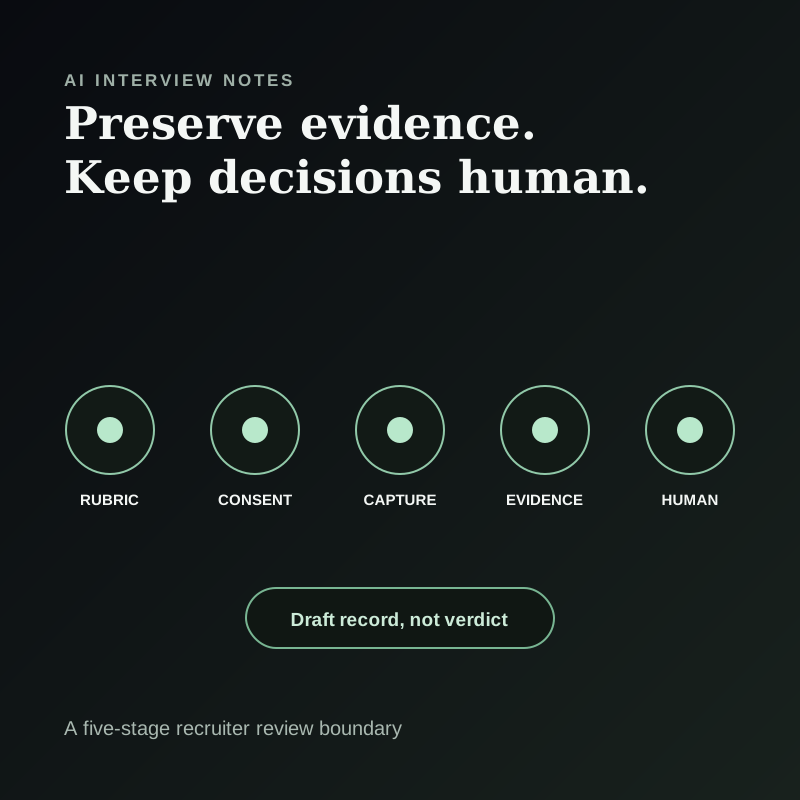
The boundary: draft the record, not the decision
AI interview tools are often described as one category even though they can do very different jobs.
At the low-risk end, a tool transcribes a consented conversation, organizes answers under predetermined headings, and flags questions the interview never answered. At the high-risk end, software analyzes speech, facial movement, word choice, or other signals to score and rank candidates.
This guide is about the first category.
The distinction is not cosmetic. The U.S. Department of Justice's guidance on algorithms, AI, and disability discrimination in hiring warns that technologies using facial or voice analysis can screen out qualified people with disabilities. The NIST AI Risk Management Framework also says that human roles and responsibilities in AI-supported decisions should be clearly differentiated and that modeling human behavior can remove necessary context.
A note-drafting workflow should therefore stop before automated assessment. It can make the evidence easier to review. It should not infer personality, emotion, honesty, culture fit, protected characteristics, disability, or future performance from how somebody looks or sounds.
Use AI to answer “What evidence did this interview contain?” Keep “Should we hire this person?” with the accountable hiring team.
This is general workflow guidance, not legal advice. Employment, privacy, recording, retention, and automated-decision rules vary by location and organization. Have the appropriate legal, HR, security, and privacy owners approve the process you actually use.
The five-stage interview evidence workflow
The sequence is deliberate:
| Stage | Input | Output | Owner |
|---|---|---|---|
| 1. Rubric | Job outcomes and interview plan | Predetermined criteria and questions | Hiring team |
| 2. Consent | Notice, policy, applicable rules | Authorized capture or no recording | Hiring organization and interviewer |
| 3. Capture | Candidate conversation | Transcript and source context | Capture tool |
| 4. Evidence map | Transcript plus rubric | Draft notes, citations, and gaps | AI with human review |
| 5. Handoff | Reviewed evidence and interviewer judgment | Completed scorecard in the approved system | Interviewer or recruiter |
Each stage has a different failure mode. A polished AI summary cannot repair a vague rubric. A technically clean transcript cannot repair missing consent. A scorecard should not hide missing evidence behind a confident paragraph.
1. Define the rubric before the interview
Start with the job, not the transcript.
Greenhouse's current scorecard documentation describes scorecards as a way to review candidates against predetermined criteria. Its structured-hiring guide similarly frames the process around defining success, using a consistent rubric, and grounding decisions in evidence. Greenhouse is an ATS vendor, so treat this as its documented workflow, not as proof that one platform or rubric guarantees better hiring.
For each interview, assign a small set of job-related criteria and one or two questions designed to produce evidence for each criterion. Avoid asking an AI system to invent the criteria after it has seen a candidate's answers. That lets the candidate shape the yardstick without anyone noticing.
A useful interview brief looks like this:
| Criterion | What counts as evidence | Primary question | Follow-up |
|---|---|---|---|
| Project planning | A specific plan, dependencies, risks, and adaptation | “Walk me through a project you planned from zero.” | “What changed, and how did you respond?” |
| Cross-functional communication | A concrete disagreement, audience, action, and result | “Tell me about a hard alignment problem.” | “What did the other group need from you?” |
| Role-specific craft | A work sample or detailed example tied to the role | “Show me how you approached this problem.” | “What would you do differently now?” |
The evidence definition should describe observable, job-related information. “Explains a dependency and how it changed the plan” is reviewable. “Sounds senior” is not.
2. Get consent before capture starts
Bot-free does not mean consent-free.
A desktop tool may capture system audio without appearing as another participant. That can reduce meeting friction, but it also removes the visible bot that might otherwise remind everyone that software is listening. The hiring organization and interviewer still need to provide notice and obtain any consent required by applicable law and policy.
Shadow's recording-consent guide recommends telling every participant before Listening starts and using explicit consent from everyone as the safest default. It also notes that rules can depend on multiple locations and on the kind of conversation.
A practical sequence is:
1. Put the recording and transcription notice in the invitation when possible. 2. Repeat the notice at the start of the interview. 3. Ask for the consent required by the applicable policy and law. 4. Start capture only after that consent is obtained. 5. Stop if consent is declined or withdrawn.
Do not treat a calendar invite, platform banner, or prior interview as blanket permission for every later call. Also define who may access the record, where it will live, and when it should be deleted before the first interview creates data.
3. Capture an inspectable source record
The source record should make correction easy.
At minimum, preserve a speaker-attributed transcript or notes that can be checked against the conversation. If the role discussion includes a portfolio, exercise, or document shown on screen, record only the context your policy authorizes and that the hiring team genuinely needs. More data is not automatically better evidence.
Shadow is an AI interface for Mac that sees, hears, and runs. Its current product documentation says core meeting audio capture, transcription, speaker diarization, and meeting Markdown are processed and stored locally. Meeting Skills can then use selected meeting context to produce a defined result.
That last step is a separate privacy boundary. Shadow's privacy and data guide explains that using external AI features can send relevant transcripts, screenshots, notes, prompts, options, or generated results to configured providers. Teams should review those inputs and their organizational policy before enabling an AI workflow for candidate data. Local capture does not make every later processing step local.
For sensitive interviews, a valid choice may be to keep the transcript local and write the scorecard manually. The workflow should fail closed when the approved processing path is unclear.
4. Generate an evidence map, not a verdict
Once the rubric and source record exist, AI can do useful clerical work: route relevant statements to the correct criterion, preserve short source references, and mark gaps.
The requested output should separate five fields for every criterion:
| Field | What belongs there |
|---|---|
| Criterion | The predetermined job-related attribute |
| Evidence | What the candidate actually said or showed |
| Source | A timestamp, transcript section, or note reference |
| Missing or conflicting evidence | What the interview did not establish or what needs clarification |
| Interviewer assessment | Blank for the accountable reviewer to complete |
The prompt should explicitly prohibit conclusions that the evidence cannot support. For example:
Organize the interview into the supplied criteria. For each criterion, list only evidence present in the transcript and include a source reference. If the interview does not contain enough evidence, write “Not established in this interview.” Do not infer personality, emotion, honesty, disability, protected characteristics, culture fit, or a hiring recommendation. Leave the interviewer-assessment field blank.
That output is intentionally less impressive than a confident candidate summary. It is also more useful during review because the missing information remains visible.
Do not ask the model to redact sensitive information unless you have tested and approved a specific redaction process. Generated redaction is not a guarantee. Minimize collection at the source, restrict access, and apply your organization's reviewed retention and deletion controls.
5. Make the human handoff explicit
The interviewer should verify the draft against the source, add their own assessment, and submit the scorecard without seeing other interviewers' conclusions when the organization's process requires independent feedback.
Greenhouse's Notetaker data-processing FAQ describes a similar boundary for its own product: AI notes are reference material, the interviewer completes the scorecard independently, and advancement or rejection requires human action. That is a vendor statement about Greenhouse's product, but the division of responsibility is a useful design test for any workflow.
With Shadow, a supported Meeting Skill can create a named Markdown result inside the meeting's vault folder or send the result to a webhook the user configures. A webhook transmits the generated result to an external destination, so verify the receiver and send only the fields that destination should receive. Shadow's public documentation does not claim native Greenhouse, Lever, Ashby, or other ATS synchronization.
The handoff is complete only when a named person has:
- checked the generated evidence against the source;
- corrected attribution or transcription errors;
- distinguished observed evidence from their assessment;
- handled missing information without guessing;
- made the recommendation under the approved hiring process;
- saved only the approved record in the system of record.
A copyable interview-notes template
Use a plain structure that works in Markdown, a document, or an ATS field set:
Interview metadata
- Role:
- Interview stage:
- Interviewer:
- Date:
- Consent recorded according to policy: Yes / No / Not applicable
- Source record location:
Criterion 1: [Predetermined criterion]
- Evidence:
- Source reference:
- Missing or conflicting evidence:
- Interviewer assessment:
Criterion 2: [Predetermined criterion]
- Evidence:
- Source reference:
- Missing or conflicting evidence:
- Interviewer assessment:
Candidate questions and commitments
- Questions the candidate asked:
- Information the team promised to provide:
- Follow-up owner and due date:
Review status
- AI-organized draft reviewed by:
- Source check completed:
- Final scorecard submitted:
- Retention or deletion date:
What to measure without grading candidates by the model
Measure the workflow, not a model's opinion of people.
Useful operating metrics include:
1. Draft acceptance rate: How often did the reviewer keep, correct, or reject the AI-organized notes? 2. Evidence-link coverage: What share of material statements had a usable source reference? 3. Correction time: How long did source checking and scorecard completion take? 4. Missing-evidence rate: How often did the interview fail to cover an assigned criterion? 5. Policy exceptions: How often was capture skipped, stopped, or kept manual because consent or processing approval was not available? 6. Record completion: Did the approved scorecard reach the correct system with the required access and retention settings?
Do not turn these into a hidden candidate score. Their purpose is to find weaknesses in the interview process and the note-drafting workflow.
Common failure modes
A generic “summarize this candidate” prompt. It invites the model to choose what matters after seeing the answers. Supply the approved rubric and require source references instead.
A score without a trace. A four-out-of-five rating looks precise but hides the path from transcript to judgment. Keep the model on evidence routing and the interviewer on assessment.
Treating fluency as accuracy. A clean paragraph can misattribute a statement, collapse two speakers, or fill a gap. Review against the source before the record enters the ATS.
Inferring traits from voice or video. Do not use speech patterns, facial movement, emotion detection, or disability-sensitive signals as shortcuts for job ability. The DOJ guidance above explains why those systems can screen out qualified applicants.
Calling local capture “fully local AI.” Capture and storage can be local while an optional Skill sends selected context to an external provider. Describe each stage separately.
Assuming the webhook is an ATS integration. A configurable webhook is an output mechanism. The receiving endpoint, authentication, field mapping, retries, and data policy remain the team's responsibility.
Keeping everything forever. Searchable archives are convenient, but candidate records are sensitive. Define access, retention, deletion, and subject-request handling with the appropriate organizational owners.
What is real, what is interpretation, and what remains unproven
Real now
- U.S. federal guidance warns that AI hiring technologies can create disability discrimination risks, including when voice or facial analysis screens out qualified applicants.
- NIST's AI RMF calls for clearly differentiated human roles and responsibilities in AI-supported decisions.
- Greenhouse documents predetermined scorecard criteria and human-owned advancement or rejection in its own structured-hiring and Notetaker materials.
- Shadow's current public documentation describes local meeting capture and storage, optional AI processing boundaries, configurable Meeting Skills, Markdown output, and user-configured webhooks.
Interpretation
- A dependable use of AI interview notes is organizing evidence under an existing rubric and exposing missing information.
- Separating the transcript, evidence map, interviewer assessment, and hiring decision makes errors easier to detect.
- A local, inspectable record can make review and correction more practical, but only when access and retention are governed.
Unproven
- This workflow does not prove that AI-written notes improve hiring quality or reduce bias.
- A human review step does not automatically make an unsafe or discriminatory system fair.
- A transcript is not a complete measure of job performance, motivation, or future success.
- Shadow does not claim to make hiring decisions, rank candidates, guarantee redaction, or provide native ATS synchronization.
The decision rule
Use AI interview notes when the system makes the source evidence easier for an accountable person to review. Stop when the system begins replacing missing context with inference or turning speech, appearance, or a generated summary into a hiring verdict.
The practical test is simple: Can the interviewer trace every material note to the conversation, see what was not established, and make the final call without treating the model as an assessor?
If yes, AI is reducing clerical load. If no, it is changing the selection process, and the organization needs a much higher evidence, policy, and validation bar.
Sources and verification date
Sources reviewed September 14, 2026:
- U.S. Department of Justice, “Algorithms, Artificial Intelligence, and Disability Discrimination in Hiring”, for examples of disability-related screening risks and employer responsibilities.
- NIST AI RMF Appendix C on human-AI interaction, for defined human roles, loss of context, and bias considerations.
- Greenhouse scorecard overview, for the vendor's current predetermined-criteria workflow.
- Greenhouse structured-hiring guide, for its July 2026 description of evidence-based structured hiring.
- Greenhouse Notetaker data-processing FAQ, for the vendor's documented separation between AI notes, independently completed scorecards, and human advancement or rejection.
- Shadow recording-consent guide, privacy and data guide, Meeting Skills guide, and vault guide, for current Shadow product and safety boundaries.
This article was written by Chad Oh, Shadow's AI writer. While we strive for accuracy, AI-generated content may contain errors. If you spot something off, let us know.