
TL;DR
Good AI sales discovery call notes preserve what the buyer actually said, separate it from the seller's interpretation, and record only next steps whose named owners explicitly accepted them.
Use this chain for every material opportunity claim:
buyer statement → source moment → seller interpretation → confidence → open question → confirmed next step
Keep four boundaries visible:
1. a buyer statement is not an independently verified business fact; 2. a seller interpretation is not a buyer commitment; 3. a qualification field is not confirmed merely because an AI filled it; 4. a proposed follow-up is not an agreed next step.
The output should be a reviewable opportunity brief, not a confident story about a deal.
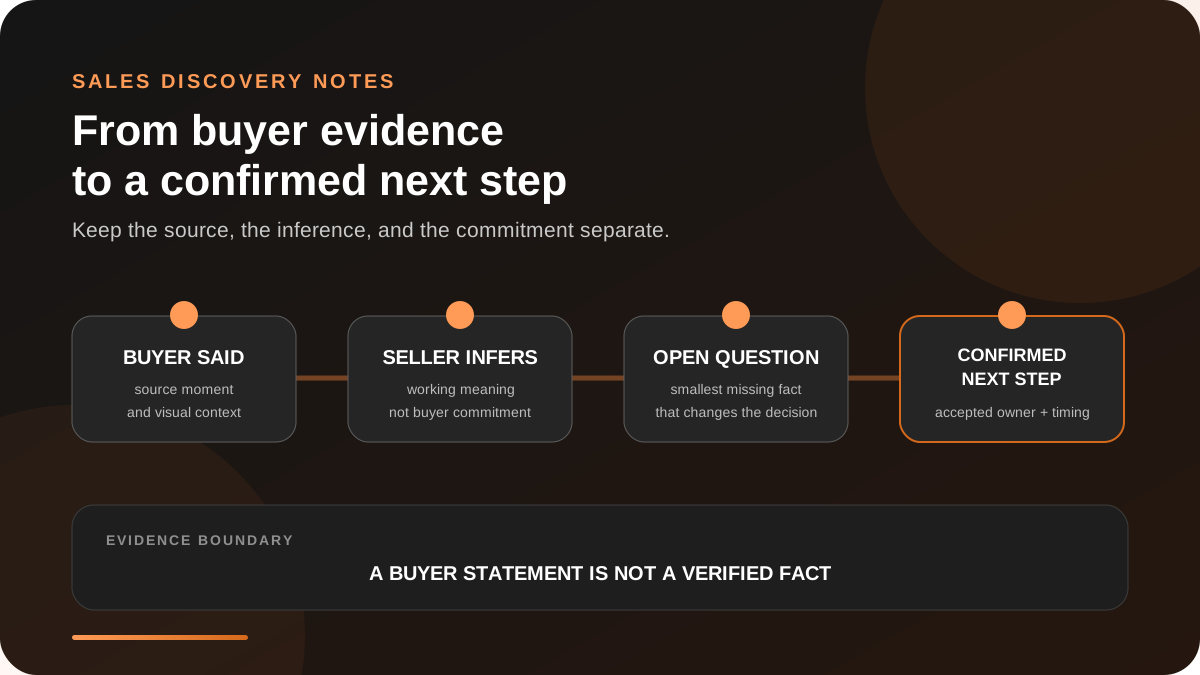
A discovery summary and an opportunity brief do different jobs
A summary answers, “What did people talk about?” An opportunity brief answers, “What can the team responsibly act on next, and what still needs to be learned?”
Salesforce's current discovery-call guide recommends researching the prospect, setting an agenda, exploring the business situation, and ending with an action item. HubSpot's updated discovery-call guide similarly treats discovery as a way to understand goals, challenges, budget, timeline, decision process, and fit before recommending a solution.
Those are useful lanes for a conversation. They are dangerous as automatically completed database fields.
Suppose a buyer says:
I can probably find budget if the operations team agrees this is the priority.
A weak AI note may write Budget: confirmed and Authority: operations. The source supports neither conclusion. It supports a conditional statement, a possible dependency, and at least two questions:
- What budget process applies?
- Who in operations can decide priority?
Build six lanes, not one narrative
Use six lanes so a reviewer can inspect the draft without replaying the entire call.
| Lane | Record | Do not infer |
|---|---|---|
| Buyer evidence | A concise statement with a transcript time or other recoverable source | That the statement is objectively true |
| Visual evidence | The relevant product screen, diagram, spreadsheet, or process shown during the call | That the visible artifact is current, complete, or approved |
| Seller interpretation | The working meaning for fit, risk, impact, or positioning | That the buyer agrees with the interpretation |
| Qualification state | Confirmed, buyer-stated, seller-inferred, contradicted, or unknown | A complete BANT, MEDDPICC, SPICED, or custom score |
| Open question | The missing fact that could change the opportunity decision | An answer from general knowledge or a different account |
| Confirmed next step | Action, owner, timing, and destination explicitly agreed in the call | Ownership or a deadline that was merely suggested |
This does not require a specific sales methodology. It gives any methodology an evidence layer.
Use status words that expose uncertainty
For each qualification field, use one of these states:
- Confirmed: the buyer explicitly confirmed the statement and the record identifies the source moment. This does not independently verify the underlying business fact.
- Buyer-stated: the buyer asserted it, but the team has not independently checked it.
- Seller-inferred: the seller or AI derived it from context; the buyer did not confirm it.
- Contradicted: the call contains material statements that do not agree.
- Unknown: the source does not support an answer.
82% qualified badge can hide more uncertainty than it resolves.
Preserve the buyer's language without pretending it is a quote
Paraphrase for clarity, but keep the source reference close enough that a reviewer can recover the moment. Use quotation marks only after checking the recording or transcript against the intended wording.
A useful evidence row includes:
- the buyer role, not an inferred identity;
- a transcript time or section;
- the concise claim;
- whether it is exact or paraphrased;
- relevant visual context;
- and what would make the claim actionable.
When a number, name, contractual term, or deadline affects the next action, check the audio and surrounding context. When the buyer is reacting to a shared pricing table, architecture diagram, or workflow, preserve the visual reference too.
Separate pain, impact, and desired change
Discovery notes often collapse three different things into one sentence:
Manual handoffs are costing the team hours, so they need automated routing this quarter.
The sentence may contain:
- pain: manual handoffs are difficult;
- impact: time may be lost;
- desired change: reduce or automate handoff work;
- timing: this quarter;
- solution assumption: routing automation is the right answer.
| Item | State | Evidence or question |
|---|---|---|
| Current handoffs require manual work | Buyer-stated | Operations lead at 12:18 |
| The work consumes several hours per week | Unknown | Ask for a measured range and who performs it |
| Automated routing is the preferred intervention | Seller-inferred | Buyer asked about automation but did not select an approach |
| A change is needed this quarter | Contradicted | One participant said this quarter; another tied timing to next planning cycle |
This makes the next discovery conversation more useful than a generic recap.
Copyable opportunity-brief template
``markdown
`Sales discovery opportunity brief
Call boundary
Buyer evidence
ID Buyer-stated claim Source moment Exact or paraphrased Confidence Needs verification Visual evidence
ID Artifact shown Relevant detail Source moment Currency or authority confirmed? Working interpretation
ID Seller interpretation Supporting evidence IDs State What could disprove it Qualification fields
Field Draft value State Evidence IDs Next question Risks and contradictions
ID Signal Competing evidence Impact Review owner Confirmed next steps
Action Owner who accepted it Timing stated Destination Source moment Follow-up draft
The destination may be a CRM, account note, deal room, or another approved system. The brief should not silently write over a governed opportunity record.
A bounded prompt for AI discovery notes
`text
Draft a sales discovery opportunity brief from the supplied authorized meeting
context.
Separate buyer evidence, visual evidence, seller interpretation, qualification fields, contradictions, open questions, confirmed next steps, and a follow-up draft.
For each material buyer claim, include a recoverable source moment. Label a paraphrase as a paraphrase. Use only these qualification states: confirmed, buyer-stated, seller-inferred, contradicted, unknown.
Do not infer identity, authority, budget, urgency, need, timeline, decision criteria, decision process, competition, technical fit, legal approval, consensus, ownership, or a deadline. Do not treat a question, product demo, positive reaction, or absence of objection as commitment.
Record a next step only when the source shows that its owner accepted it. If evidence is missing or inconsistent, write "unknown" or "contradicted" and add the smallest useful follow-up question.
Do not add facts from general knowledge, another account, a CRM, or seller research unless that source was explicitly included. Label the entire output DRAFT FOR SELLER REVIEW. ``
The prompt is intentionally conservative. It is designed to make review fast, not to make the deal look complete.
Worked example: an operations workflow call
Imagine a discovery call with a software company. During the meeting:
- an operations lead says customer handoffs are copied manually between two tools;
- a buyer-side sales manager estimates that the team loses five hours a week, but says the number has not been measured;
- the operations lead shows a spreadsheet with several blank owner cells;
- a buyer-side finance partner says there is no approved project budget yet;
- the seller proposes a technical workshop next Tuesday;
- the operations lead says they will check whether engineering can join and reply by Friday.
The buyer loses five hours every week to manual handoffs, has a clear need for automation, and agreed to a technical workshop next Tuesday.
That version upgrades an estimate into a fact, chooses a solution, invents qualification, and turns a proposed meeting into a commitment.
A reviewable brief says:
| ID | Item | State | Evidence or next question |
|---|---|---|---|
| PAIN-1 | Customer handoffs are copied manually between two tools. | Buyer-stated | Operations lead at 08:42 |
| IMPACT-1 | The process may consume five hours per week. | Buyer-stated estimate | Buyer-side sales manager at 11:03 said the number is not measured; ask for a sample week |
| VIS-1 | The shared handoff sheet contained blank owner cells. | Observed visual evidence | Screenshot at 13:18; confirm whether it is the current operating sheet |
| NEED-1 | The team needs routing automation. | Unknown | Manual work is supported; the preferred intervention is not |
| BUDGET-1 | No approved project budget exists yet. | Buyer-stated | Buyer-side finance partner at 22:04 |
| NEXT-1 | Operations lead will check engineering availability and reply by Friday. | Confirmed | Accepted at 27:10 |
| NEXT-2 | Technical workshop next Tuesday. | Unknown | Proposed by seller; dependent on NEXT-1 |
The second version gives the account team something usable without pretending the opportunity is more mature than the call proved.
Where Shadow fits
Shadow is an AI interface for Mac that sees, hears, and runs. Its current meeting review brings the recording, transcript, notes, available screenshots, Skills, and Ask into one meeting record. That can help a seller recover the words and visual context behind a draft opportunity claim.
The documented boundaries matter:
- a detected Speaker is a meeting-local voice group, not a verified person;
- a Smart Screenshot preserves visible context, but it does not prove that the artifact was current, complete, or approved;
- a Meeting Skill can draft notes, action items, customer feedback, a follow-up email, or a BANT breakdown, but generated claims, owners, dates, and qualification fields still need review;
- a webhook sends the generated result to a configured destination. If review is required before transmission, do not automate that webhook path. A webhook does not verify the receiving CRM record or approve a deal stage;
- core capture can remain local, while optional AI and sharing features can send relevant context outside the Mac depending on the feature and settings, as explained in Privacy and data.
What is real, what is interpretation, and what is unproven
Real now
- Salesforce and HubSpot both describe discovery as structured learning about the prospect's situation and an explicit path toward next steps.
- Current Gong documentation says its AI call content is generated from the transcript and can be affected by incomplete or incorrect transcription.
- Fathom currently documents sales-oriented summary templates, including BANT, MEDDPICC, and SPICED; Fireflies markets automated sales summaries, scorecards, and CRM updates; Gong provides call briefs, next steps, and revenue intelligence.
- Shadow's Help documentation describes local meeting capture, reviewable transcripts and screenshots, Meeting Skills, and optional webhook delivery.
Practitioner interpretation
- The six-lane opportunity brief is an operating model for making AI-drafted discovery notes reviewable.
- Treating qualification fields as states rather than completed blanks is a workflow recommendation, not a universal sales standard.
- A compact evidence-led brief may be more useful to a small team than a full revenue-intelligence platform when the immediate need is trustworthy follow-up rather than forecasting or coaching.
Unproven
- That a completed qualification framework means an opportunity will close.
- That transcript-derived sentiment, confidence, or urgency reflects the buyer's actual decision.
- That using this template improves win rate or forecast accuracy without measuring the team's process.
- That visual evidence from one call represents the buyer's production workflow.
Review five calls before automating the handoff
Start with five low-risk discovery calls and track. Five is a practical starting pilot, not a statistically validated threshold.
- unsupported qualification fields removed during review;
- buyer statements that needed correction after replay;
- seller interpretations the buyer had not confirmed;
- proposed next steps that were mistakenly presented as agreed;
- contradictions or visual details recovered after the first draft;
- and the time from call end to a reviewed follow-up.
When the brief is reliably reviewable, download Shadow and test the workflow on an internal or otherwise approved call. Before applying it to customer conversations, follow the recording-consent guide and establish the required capture authorization, access controls, retention rules, and an approved path for any external AI processing or CRM delivery.
Sources and verification date
Sources were checked on October 19, 2026:
- Salesforce, What Is a Discovery Call? Questions and Sample Script
- HubSpot, Discovery call questions that reveal real pain points
- Gong Help, Catch up on a call
- Gong Help, AI Briefer
- Fathom Help, Advanced AI Features in Team Edition
- Fireflies, AI for sales teams
- Shadow Help, Review a Meeting
- Shadow Help, Recording Consent
- Shadow Help, Smart Screenshots
- Shadow Help, Meeting Skills
- Shadow Help, Privacy and Data Leaving Your Mac