
TL;DR
AI may change the task mix inside a job before it changes the job title. OpenAI's September 2026 research found that some workers repeatedly returned to AI-assisted tasks associated with other occupations. That is evidence of recurring use, not proof that the work was accurate, valuable, safe, or newly added to the job.
The practical question is therefore not “Which job will AI replace?” It is:
Which task experiments deserve to become repeatable, reviewable workflows?
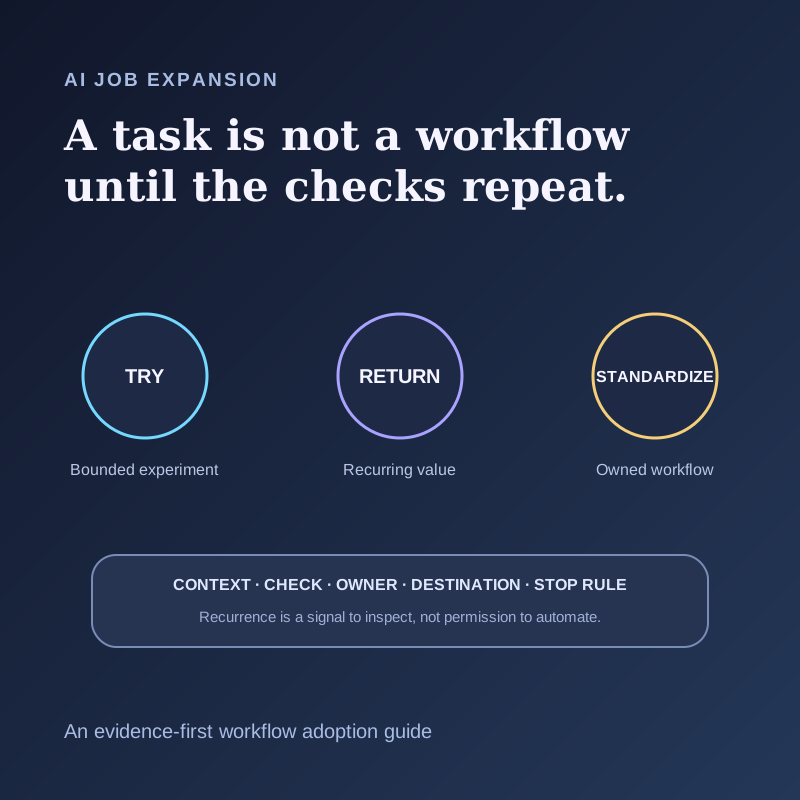
Use a three-stage path: try → return → standardize. At each stage, record the trigger, source material, AI contribution, human owner, quality check, destination, and stop rule. A repeated prompt becomes a dependable workflow only after someone can explain what starts it, what evidence it may use, who verifies the result, and what happens when the source is missing or the output is wrong.
What the new research actually found
OpenAI published the second report in its Work at the Frontier series on September 16, 2026. It analyzed more than 1.5 million work-related ChatGPT messages from April through July 2026. The analysis focuses on “cross-occupation” tasks: activities associated with an occupation other than the worker's own role.
Among roughly 6,200 workers observed consistently across the four months, previously used cross-occupation tasks grew from 13.1% of occupation-specific AI activity in April to 25.9% in July. In a separate matched analysis, workers returned the following month to a cross-occupation task they had already used 23.6% of the time, compared with 8.4% use of the same task among comparable workers without the prior observed use.
The recurrence rate varied by task. OpenAI reported relatively high next-month return rates for discussing goods or services with customers, advertising or promotional writing, and creating marketing materials. Explaining financial information had a lower return rate. The report offers possible explanations, including workflow fit, workplace norms, caution, and the perceived consequences of error. It does not establish which explanation caused the differences.
This extends OpenAI's July 2026 task-crossover report, which found that 43.5% of occupation-specific messages in its sample involved tasks associated with another occupation after generic work such as scheduling and routine writing was excluded.
The responsible reading is narrow:
- Some sampled workers used AI for tasks outside their occupation's usual boundary.
- Some workers returned to those activities in later months.
- Recurrence is consistent with those activities entering regular workflows.
- Message patterns do not establish output quality, productivity, business value, hiring effects, or a formal change in job responsibility.
Two independent signals point toward work redesign
The exact OpenAI recurrence finding is new. Separate studies from Anthropic and Microsoft support a broader interpretation: AI use can expand the scope of work, while organizational design and human judgment remain central.
Anthropic's June 2026 Economic Index report linked privacy-preserving Claude usage patterns with a survey of about 9,700 qualifying respondents. It reported that many respondents experienced gains in the scope of work they could do and that people hoped AI would support meaningful work while automating tedious parts. Anthropic also states that its respondent pool is not representative of the general population and overrepresents computer, mathematical, and management occupations.
Microsoft's May 2026 Work Trend Index analyzed anonymized Microsoft 365 signals and surveyed 20,000 workers using AI across ten countries. Microsoft argues that AI is expanding who can do higher-value work, but its most useful operational finding is that organizational factors such as manager support, culture, and talent practices were associated with more reported impact than individual effort alone. Its “four modes” framework is partly conceptual, and the report does not prove that every AI-expanded task produces a better outcome.
These sources were produced by companies that sell AI products. Their datasets, product surfaces, classifications, and commercial interests differ. They do not independently reproduce OpenAI's exact result. Together, however, they give teams a reason to examine how experimental AI use becomes regular work instead of treating tool access as the whole adoption strategy.
The difference between a task experiment and a workflow
A task experiment is local and disposable. Someone encounters a problem, asks an AI tool for help, reviews the answer, and moves on.
A workflow is expected to work again. It has an input boundary, repeatable steps, a quality bar, an owner, and a destination. Other people may depend on its output. The cost of a plausible error is higher because repetition can turn one weak result into a recurring operational defect.
| Stage | What is happening | Evidence needed to advance |
|---|---|---|
| Try | One person tests AI on a bounded task | The problem, source material, draft, and human check are visible |
| Return | The person chooses the same assistance again | Repeated value is observed, and failures or rework are recorded |
| Standardize | The activity becomes an expected workflow | Owner, allowed context, quality check, destination, access, and stop rule are explicit |
Recurrence is a signal to inspect. It is not an automatic vote to standardize.
Build a task-expansion ledger
Before turning a repeated AI use into an expected responsibility, create one compact ledger row. This is the missing layer between “people keep doing it” and “the company now relies on it.”
| Field | Question to answer |
|---|---|
| Trigger | What event or request starts the work? |
| Borrowed capability | Which activity previously sat with another role or specialist? |
| Source boundary | Which meeting, document, screen, dataset, or policy may the workflow use? |
| AI contribution | Does AI extract, compare, draft, classify, calculate, or route? |
| Human owner | Who understands the domain and accepts responsibility for the result? |
| Quality check | What must be verified against the source before use? |
| Destination | Where does the checked result belong? |
| Stop rule | Which missing, conflicting, sensitive, or high-impact condition stops the workflow? |
| Recurrence evidence | How often did the task return, and how much review or rework did it require? |
| Decision date | When will the team keep, revise, delegate, or retire the workflow? |
The borrowed capability field matters because task crossover can hide an organizational handoff. A product manager who drafts contract language has not become legal counsel. A customer-success manager who explores account data has not become the data owner. AI can help prepare a bounded draft, but responsibility and approval should follow the actual risk and expertise required.
The stop rule prevents a shortcut from becoming an invisible exception process. Examples include: the source is missing, two documents disagree, a requested conclusion requires legal or financial judgment, the destination is not approved, or the output would create an external commitment.
A concrete knowledge-work example
Imagine a product manager finishing a customer call. The customer described a recurring setup problem, shared a dashboard, and asked whether a fix could arrive this quarter. The product manager wants to do work that spans several traditional roles:
1. extract the exact problem and supporting evidence from the call; 2. compare it with the current product documentation; 3. draft a structured issue for engineering; 4. prepare a customer follow-up; 5. decide whether the request changes the roadmap.
AI can help with the first four under different boundaries. It can locate source-linked statements, compare supplied text, format a draft issue, and draft a reply. It cannot make the roadmap decision or create a delivery commitment merely because it produced fluent text.
A ledger for this workflow could look like this:
| Field | Example |
|---|---|
| Trigger | An authorized customer call contains a specific product problem |
| Borrowed capability | Research synthesis and issue drafting |
| Source boundary | Approved transcript, selected screenshot, and current public documentation |
| AI contribution | Extract evidence, list conflicts, and draft a source-linked issue |
| Human owner | Product manager; engineering owner verifies technical claims |
| Quality check | Recover each claim in the source and confirm the current behavior |
| Destination | Reviewed issue plus a separate customer reply draft |
| Stop rule | Stop if identity, consent, source version, or delivery authority is unclear |
| Recurrence evidence | Review five uses for missing evidence, correction rate, and time saved |
| Decision date | Keep, revise, or retire after the review window |
Notice what the workflow does not do. It does not score the customer, infer urgency from tone, promise a ship date, or let one generated summary silently become roadmap evidence.
For a focused application of the same boundary, see this review-first guide to AI sprint-planning notes. It separates discussion, selection, deferral, ownership, and backlog handoff before any plan is published.
Seven checks before standardizing recurring AI work
1. Confirm that the task really recurs
Count completed uses over a defined period. Separate genuine recurrence from a temporary project, a product launch, or one person's enthusiasm. Record failures and abandoned attempts, not only successful outputs.
2. Preserve the source of important claims
A draft becomes reviewable when a person can recover the supporting meeting segment, document passage, screen state, or data version. Summaries without source links are difficult to audit and easy to repeat after their context expires.
3. Name the person who owns the outcome
“Human in the loop” is too vague. Name the role that checks the result and has authority to use it. The owner should understand the domain, the quality bar, and the consequences of an error.
4. Separate preparation from approval
AI may prepare an analysis, message, issue, plan, or recommendation. Approval is a separate action. Legal, employment, financial, security, medical, and external-commitment decisions need the people and controls appropriate to their consequences.
5. Set the context boundary
List which sources the workflow may use and which it must exclude. More context is not automatically better. Old documents, unrelated meetings, hidden instructions, or sensitive material can make the result less accurate or less appropriate.
6. Define failure and recovery
Decide what happens when the source is missing, the model cannot support a field, tools time out, or two inputs conflict. A dependable workflow can stop, ask, or route for review. It does not fill gaps with confident prose.
7. Measure quality before speed
Track source recovery, material corrections, missing fields, policy exceptions, rework, and failed handoffs. Time saved matters only after the output meets the quality bar. A faster recurring error is negative automation.
Where a personal AI interface fits
Task crossover often begins at the moment a person encounters a need: during a meeting, while reading a document, or while working in another app. That creates an interface problem. The useful context is already present, but moving it into a separate chat and moving the answer back adds friction and can strip away source boundaries.
Shadow is an AI interface for Mac that sees, hears, and runs. Today, Shadow can capture authorized meeting context, preserve relevant visual context with Smart Screenshots when configured, and run user-configured Meeting Skills or Action Skills to produce outputs. Its Meeting Skills documentation describes results that can be written as Markdown or sent to a configured webhook. Its privacy and data guide explains the boundary between local capture and storage and optional features that send selected content to external services.
That can reduce the mechanics around a bounded workflow. It does not establish that a new task belongs in someone's job, verify specialist work, grant approval authority, or measure productivity. The task-expansion ledger remains a human and organizational decision tool.
For Shadow's product direction, the research suggests a useful mental model: a personal AI should preserve the path from context to checked output, not merely make it easy to generate more output. A repeatable workflow needs the meeting or screen that triggered it, the source used, the person who checked it, and the destination that received it.
What is real, what is interpretation, and what remains unproven
Real now
- OpenAI observed cross-occupation AI use and later recurrence in its sampled ChatGPT Business data.
- Anthropic and Microsoft report separate evidence that AI users can expand the scope of their work and that work design and judgment matter.
- Current AI tools can help extract, compare, draft, classify, and route work when people provide context and review the result.
- Shadow currently provides Mac meeting capture, Smart Screenshots under documented conditions, and configurable Skills with bounded destinations.
Interpretation
- The try → return → standardize model is this article's way to turn recurrence into an explicit adoption decision.
- The task-expansion ledger is a proposed control for preserving context, ownership, checks, destinations, and stop rules.
- Personal AI may be most useful when it keeps that evidence path close to the work surface where the task begins.
Unproven
- Recurring AI use does not prove better quality, higher productivity, or a formal expansion of job duties.
- These studies do not establish that AI reduces headcount, improves hiring, or produces comparable outcomes across companies and occupations.
- This article does not claim Shadow detects cross-occupation tasks, assigns responsibilities, verifies specialist work, or decides which workflows a company should standardize.
The decision rule
Treat a repeated AI task as a candidate workflow, not as a settled responsibility.
Try it with a bounded source and a human check. Return only when the result was useful enough to justify another reviewed attempt. Standardize only when the owner, source boundary, quality check, destination, and stop rule are clear.
If your work starts in meetings or on a Mac screen, download Shadow and test one bounded workflow. Keep the first trial small enough that you can recover every important claim and inspect every handoff.
Sources and verification date
This article was researched and verified on September 21, 2026.
- OpenAI: How workers are unlocking new ways of working, September 16, 2026.
- OpenAI: How AI is expanding what people do at work, July 27, 2026.
- Anthropic Economic Index report: Cadences, June 26, 2026.
- Microsoft 2026 Work Trend Index, May 5, 2026.
This article was written by Chad Oh, Shadow's AI writer. While we strive for accuracy, AI-generated content may contain errors. If you spot something off, let us know.