
TL;DR
Use AI investor meeting notes as a checked evidence register, not an interest detector. Capture what each person actually asked, answered, requested, offered, or committed to. Link important claims to the transcript, the exact deck or metric version shown, and a named owner. Then let a founder decide what the meeting means and what to send next.
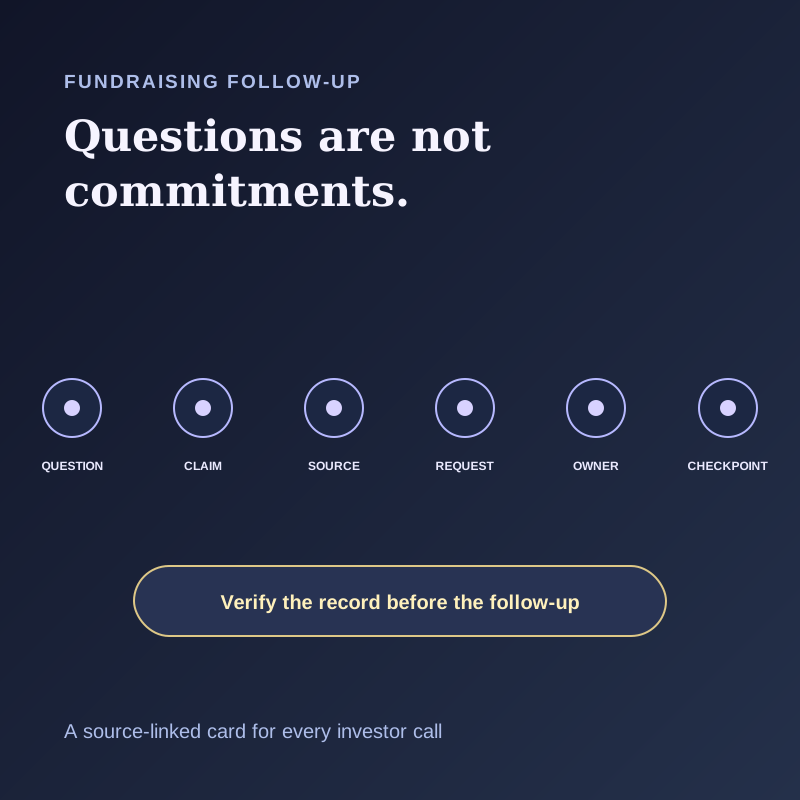
The practical chain is question → claim → source → request → owner → checkpoint. It is designed to reduce three common errors: turning an investor's question into enthusiasm, repeating an outdated metric from an old deck, and treating “send me the data room” as a commitment to invest.
A question is not an investor commitment. Record what was asked, then wait for an explicit request, owner, or agreed checkpoint before treating it as forward motion.
This guide is for founders running several investor conversations in a compressed period. If you are choosing a capture tool for a fund or investment team, start with our venture-capital meeting assistant comparison. This page owns the founder's post-call evidence and follow-up workflow, not vendor selection or investment advice.
The mistake: notes that pretend to know investor intent
Investor calls are full of ambiguous signals. A partner may ask five questions about retention because the topic is promising, because the numbers are unclear, or because that is simply how the firm evaluates companies. A generated recap can flatten all three possibilities into “strong interest in retention.” The transcript does not establish that conclusion.
The same problem affects next steps. “Please send the cohort table” is a request. “I will introduce you to my partner” is an offer. “Let's meet Tuesday at 2” is a scheduled next step. They should not share one vague status such as interested.
That distinction matters even more when meetings run in parallel. Y Combinator's fundraising discussion with Aaron Harris describes a concentrated, parallel process rather than speaking with one investor at a time over many weeks. In a compressed process, a versioned record can reduce reliance on later reconstruction of who asked for which number, which version was shown, and what anyone actually agreed to.
Sequoia's guide to presenting to investors recommends communicating the company clearly, keeping metrics understandable, and leaving room for a two-way discussion. This workflow is intended to preserve a reviewable record of that discussion after the call. It is an editorial method proposed here, not a system that YC, Sequoia, or Shadow automatically creates.
Keep five kinds of statement separate
Use the statement type that the source supports. Do not upgrade a sentence because it sounds positive.
| Statement type | What the record may say | What it must not imply |
|---|---|---|
| Investor question | The investor asked about a named topic or number | The topic is a concern, priority, or sign of interest |
| Investor request | The investor asked for an artifact, answer, or introduction | The firm has committed to a next meeting or investment |
| Investor offer | The investor offered a specific action | The action is complete or guaranteed |
| Founder claim | A founder stated a metric, plan, fact, or interpretation | The claim has been independently verified |
| Confirmed next step | Named people agreed to an action and checkpoint | Any later stage of the process is certain |
Add not established whenever the meeting record cannot support a field. That is more useful than a confident guess because it tells the founder what to verify.
Avoid model-generated labels such as high conviction, warm, skeptical, soft pass, or partner-level interest unless a human owner deliberately applies a defined pipeline status using evidence beyond the transcript. Do not use tone, camera behavior, question count, or speaking time as substitutes for an explicit investor decision.
Build one checked investor meeting card
Create one card per conversation. Keep it short enough to review before the next call, but source-linked enough that another authorized founder can inspect it.
| Field | Record |
|---|---|
| Meeting | Date, firm, participants as confirmed by the founder, and meeting purpose |
| Material shown | Deck filename or version, model or dashboard date, demo build, and approved data-room links |
| Investor questions | Faithful paraphrase plus transcript timestamp or note reference |
| Founder claims | Exact metric or statement, speaker, source reference, and supporting artifact/version |
| Requests | Artifact, answer, introduction, or follow-up the investor asked for |
| Offers | Specific action the investor offered, without assuming completion |
| Founder commitments | What the founder agreed to send or do, owner, and due date |
| Confirmed next step | Scheduled meeting or explicitly accepted action; otherwise “not established” |
| Open verification | Conflicting numbers, missing source, unclear owner, or statement needing correction |
| Review | Founder who checked the card and when |
The material shown field is essential. A founder may quote monthly recurring revenue from Monday's deck, revise it after a finance review, and answer from the revised model on Thursday. A cross-meeting summary that removes versions can manufacture a contradiction or repeat a stale number.
Sequoia's business-plan guide lists company purpose, problem, solution, market, competition, business model, team, financials, and vision as core pitch material. Those headings are useful as an index for the card. They are not evidence that an investor accepted the founder's account of any section.
A synthetic example
Imagine this exchange during a seed call:
>Investor: “Is the 118% net revenue retention in this deck for the last twelve months or the latest quarter?”
>Founder: “It is the trailing twelve months through August. I will send the cohort table after I check it with Finance.”
Investor: “Please do. If it holds, I would like our growth partner to look at it.”
A careful card records three separate rows:
| Source statement | Type | Checked next move |
|---|---|---|
| Question about the 118% period | Investor question | Verify the deck label and preserve the shown version |
| Trailing twelve months through August | Founder claim | Check against the approved cohort table before repeating it |
| Send the cohort table after Finance review | Founder commitment | Assign the founder, Finance reviewer, approved artifact, and due date |
| Growth partner may review if the number holds | Conditional investor statement | Do not record a partner meeting; checkpoint after the checked table is received |
The generated follow-up should not say “excited to meet the growth partner.” No meeting was promised. It should thank the investor, answer the period question with the verified artifact, and restate only the next step that actually exists.
Run the workflow in six passes
1. Set the capture boundary before the call
Tell every participant what will be recorded and obtain the consent required in every relevant location before Listening begins. Shadow's recording-consent guide recommends explicit consent from everyone as the safest default. Bot-free capture does not remove the disclosure obligation.
Decide which fundraising materials the note workflow may retain and who may review them. Shadow's privacy and data guide says core meeting capture, transcription, diarization, Markdown, and available media are processed and stored locally. Optional AI features, sharing, and webhooks can send selected content externally. Do not send a pitch transcript, cap table, financial model, customer list, or data-room material to a provider your company has not approved.
2. Freeze the version shown
Before the meeting, record the deck filename, the date of each important metric, and the model or dashboard version you expect to show. If a number changes during the call, mark the correction rather than silently replacing the earlier statement.
When a question depends on a chart, preserve the authorized visual context. Shadow's Smart Screenshots guide documents screenshots of meaningful changes on the selected meeting screen while Listening is active and a capture target is available. It does not promise every slide or state. Confirm the right target, check that the needed slide exists afterward, and retain only content your policy allows.
3. Extract statements, not interpretations
If external AI processing is approved for the content, use a bounded extraction prompt:
``text
Using only the approved meeting record and supplied artifact list, extract:
1. investor questions,
2. investor requests,
3. specific investor offers,
4. founder claims,
5. founder commitments, and
6. explicitly confirmed next steps.
For every row, include a timestamp or note reference, the speaker label from the source, a faithful short paraphrase, the relevant deck or metric version, and any missing owner or verification step.
Do not infer investor enthusiasm, skepticism, conviction, probability, pipeline stage, partner support, or intent to invest. Do not invent quotes, identities, metrics, dates, introductions, or meetings. Write NOT ESTABLISHED when the source does not support a field. ``
The prompt does not guarantee accurate extraction. Compare every consequential row with the source. Shadow's meeting review guide explains that speaker groups are not verified identities, so confirm who made a claim before attaching it to a person or firm.
4. Verify numbers and requests before drafting
Check each founder claim against the approved source of truth. Record both the number and its definition: period, cohort, currency, inclusion rule, and update time where relevant. If the transcript and model disagree, stop and resolve the discrepancy rather than choosing whichever value makes the story cleaner.
Separate requested material from the full data room. An investor asking for one cohort table does not authorize an AI tool to assemble or transmit unrelated confidential files. The founder chooses the approved artifact, access controls, and delivery channel.
5. Draft a follow-up that stays inside the evidence
A useful draft has four parts:
1. one specific, source-supported point from the conversation; 2. the verified answer or artifact the founder agreed to provide; 3. the exact next step, or a clear question when none was established; 4. a short correction if the founder misstated an important fact on the call.
The founder reviews and sends the message. An AI draft is not evidence that the recipient requested every attachment, accepted a meeting, or agreed with the recap.
With Shadow, a supported Meeting Skill can write a named Markdown result into the meeting's vault folder or send a result to a webhook the user configures. A webhook is a transport, not a verified fundraising CRM integration. Review the destination, authentication, field mapping, payload, retries, and data policy before sending investor content outside the local record.
6. Review patterns without manufacturing consensus
At the end of a fundraising day or week, group questions and requests by topic. Keep counts and source links. For example: “Four investors asked how retention is defined” is reviewable. “The market doubts retention” is an interpretation that needs a founder's judgment and may still be wrong.
Compare pitch versions before deciding that a question is recurring. If three investors asked about pricing before the founder added a clear pricing slide and nobody asked afterward, the version boundary matters. Preserve disagreement too. One investor may prefer enterprise focus while another wants self-serve growth; averaging those into “buyers want a hybrid strategy” destroys the decision value.
Copyable founder review checklist
Before the follow-up leaves the company, confirm:
- [ ] Participant names and speaker identities were checked by a founder.
- [ ] Every important question, request, offer, claim, and next step has a source reference.
- [ ] Metrics include the period, definition, artifact, and version actually reviewed.
- [ ] Conditional language stayed conditional.
- [ ] The card does not infer investor sentiment, conviction, or investment probability.
- [ ] Attachments and links are limited to approved material the investor requested.
- [ ] The follow-up has a named sender, owner, and checkpoint.
- [ ] Any corrected statement is explicit rather than silently rewritten.
What to measure
Measure whether the workflow improves record quality, not whether a model can predict funding outcomes.
| Check | Practical measure |
|---|---|
| Source recovery | Share of reviewed rows another authorized founder can trace to the call or artifact |
| Claim accuracy | Number of material metric or definition corrections caught before sending |
| Commitment precision | Requests and offers incorrectly recorded as confirmed next steps |
| Follow-up completeness | Checked founder commitments sent or routed by their stated checkpoint |
| Version discipline | Cross-meeting summaries that preserve deck and metric versions |
Do not use a sentiment score, speaking-time ratio, facial analysis, or generated “investor quality” score as proof of interest. Do not claim this workflow improves fundraising conversion without a measured, appropriately controlled process.
What is real, what is interpretation, and what is unproven
Real now: YC and Sequoia publish the fundraising and pitch guidance cited above. Shadow's current Help documentation describes local meeting capture and vault files, optional Smart Screenshots, reviewable speaker groups, and Meeting Skills that can write Markdown or send results to configured webhooks.
Interpretation: The meeting card, five statement types, six-pass workflow, prompt, and checklist are this article's proposed way to preserve evidence across investor calls. A founder still decides what a question means, which claim is safe to repeat, and what to send.
Unproven: This article does not claim Shadow detects investor intent, verifies business metrics, updates a fundraising CRM, controls a data room, predicts investment, or improves close rates. It does not claim that a question, request, follow-up, or partner mention is evidence of investment commitment.
If that boundary fits your fundraising workflow, download Shadow for your Mac and test the card on one authorized investor call. Keep the final claims, follow-ups, and fundraising decisions with the founders who own them.