
TL;DR
OpenAI says it has reached its internal goal of an “automated research intern”: a system that can complete well-defined research tasks under human direction, including tasks a skilled researcher might spend a few days on. That is a meaningful disclosure. It is not evidence that AI can independently choose good research questions, judge every result, or replace an expert researcher.
The most striking number in OpenAI's September 6 report is 3.1. By mid-August 2026, the company says its research organization was using the equivalent of 3.1 eight-hour agent-workdays for every human workday. Researchers were also running more experiments, using more concurrent agents, and delegating longer tasks.
But agent runtime is an input, not an outcome. OpenAI says more than half of its successful tasks estimated at four to eight hours of human effort still involved at least one human intervention. It also says high-level planning remained a minimal share of agent output tokens and cautions that its easiest metrics are difficult to connect directly to research progress.
For knowledge workers, the practical lesson is this:
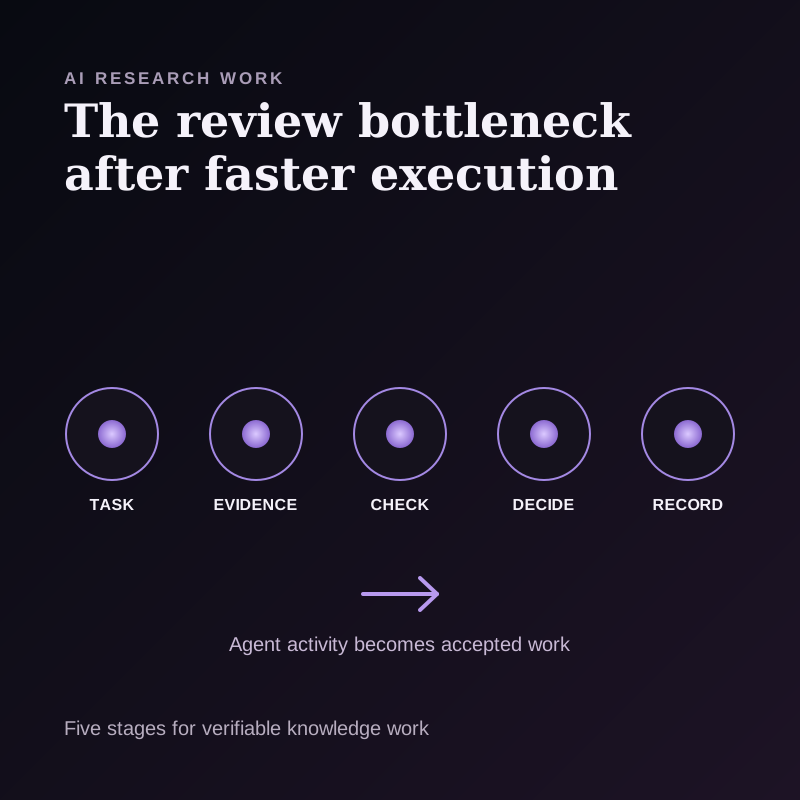
1. Define the assignment narrowly enough to verify. 2. Require an evidence packet, not just a polished answer. 3. Measure the human effort needed to accept the result. 4. Keep judgment and consequential decisions with a named person. 5. Preserve the accepted result in the system where the work continues.
That is how parallel AI work becomes useful instead of becoming a faster way to fill a review queue.
What OpenAI actually reported
OpenAI's definition matters. Its “research intern” is not described as an autonomous scientist setting the lab's agenda. The company defines it as a system that performs well-defined research tasks under human direction, including tasks that could take a skilled researcher a few days.
The report gives several indicators of changing work inside OpenAI:
| Reported signal | What it shows | What it does not show |
|---|---|---|
| 3.1 agent-workdays per human workday by mid-August | Aggregate coding-agent runtime exceeded human labor time across the research organization | A 3.1 times productivity gain or a per-researcher ratio |
| More researchers running four or more agents concurrently | Parallel agent use is becoming more common | That every task benefits from parallelism |
| August had the most experiments per active experimenter since tracking began in January 2025 | Experiment activity increased alongside agent adoption | That agents alone caused the increase or that every experiment was valuable |
| More than half of successful four-to-eight-hour tasks involved an intervention | Agents can complete longer tasks, but substantial steering remains | Fully autonomous completion |
| High-level planning remained a minimal share of agent output tokens | Most observed use still centers on execution, technical help, and monitoring | Independent research direction or judgment |
OpenAI explicitly notes two measurement problems. Available compute also increased, so the rise in experiments cannot be assigned to coding agents alone. And readily collected indicators such as generated code are hard to interpret because their relationship to research progress is uncertain.
Those limits are not footnotes to hide. They are the difference between “agents are doing more work” and “the organization is producing better accepted outcomes.”
Why agent-hours are not productivity
One hour of agent runtime is not interchangeable with one hour of expert work.
An agent can inspect several hypotheses while a person handles another decision. That concurrency is useful. It can also spend hours repeating a weak approach, misunderstanding a source, producing a plausible but irrelevant analysis, or generating work that is more expensive to check than to redo.
An independent July 2026 study of open-ended AI research shows the boundary clearly. Researchers gave frontier agents six days, substantial compute, and the central questions from two unpublished NeurIPS submissions. The abstract says the agents completed the engineering without human help, but the full paper records three run-level interventions: a harness bug fix, a 24-hour extension, and a request to rewrite an inadequate research report. The papers' original authors still judged that the agents did not make substantial progress on the actual research questions. The study reported poor judgment about the publishable bar, weak backtracking, resource mistakes, and instruction drift.
That study does not disprove OpenAI's narrower intern milestone. The tasks and evaluation methods differ. It does show why “well-defined task” is load-bearing language. Agents can be strong at execution while still struggling to decide whether the execution answers the important question.
Broader workplace evidence points in the same direction. McKinsey's August 2026 global survey found wider use of agents and individual productivity gains, while the share of respondents reporting enterprise-level EBIT impact remained essentially unchanged from the prior year. A smaller G2 Research interview study of 104 business professionals found that human-led workflows and verification remained the dominant pattern. These studies have different samples and should not be treated as a single universal estimate. Together, they suggest that reported adoption and individual gains are rising while verification remains common and enterprise-level EBIT impact was flat in McKinsey's sample.
The new bottleneck is the acceptance loop
When execution becomes cheaper, the scarce resource moves.
The old bottleneck may have been writing the first analysis, checking five documents, or running three experiments. The new bottleneck is often deciding which assignment matters, supplying authoritative context, checking the result, and committing to the next action.
I call that the acceptance loop:
1. Task: What exact question should this run answer? 2. Evidence: Which sources, observations, and artifacts support the result? 3. Check: What test would expose a wrong or incomplete answer? 4. Decision: Who accepts, rejects, or redirects the work? 5. Record: Where does the accepted result live so the next person or agent can use it?
The loop is deliberately stricter than “human in the loop.” A person who receives ten polished reports with no sources, no acceptance criteria, and no record of what changed is technically involved but operationally overwhelmed.
Each stage needs a concrete artifact.
1. Task: define a finish line
“Research our competitors” is not a verifiable assignment. “Compare the current public pricing and export options of these three products, using official documentation reviewed today, and flag anything that cannot be confirmed” is.
A useful task states:
- The decision it should inform.
- The allowed scope and sources.
- The expected output.
- The failure state when evidence is missing.
- The time, cost, and tool limits.
2. Evidence: return the trail with the answer
The deliverable should not be only a conclusion. It should include the claims, supporting sources, dates, material contradictions, and any data transformations.
For a customer-research question, the evidence packet might contain:
- The exact interview excerpts behind each theme.
- The number of conversations reviewed.
- Counterexamples that did not fit the theme.
- Product or support data used to test the interpretation.
- A clear line between observed facts and the analyst's inference.
3. Check: make errors cheaper to find
Acceptance criteria should be visible before the run begins. Depending on the task, a check could be a test suite, a reconciliation against a known total, a source-by-source claim review, a policy rule, or a second analysis designed to find counterevidence.
The best check is not always another agent. Independent review can help, but two models can repeat the same mistaken premise. Some facts need a primary source. Some calculations need a deterministic test. Some decisions need a person with context and accountability.
The useful question is not “Did another AI agree?” It is “What evidence would make this result fail?”
4. Decision: keep authority explicit
OpenAI's report says people still set priorities, judge which ideas to pursue, and decide whether to scale, pause, or deploy. That division is relevant outside a research lab.
A sales leader can ask agents to analyze calls, objections, and pipeline notes. The leader still owns the decision to change positioning. A product researcher can ask agents to compare interview themes. The researcher still decides whether the evidence warrants a roadmap change.
Authority should become more explicit as execution scales. Every consequential result needs a named decision owner, a visible status, and a reason for acceptance or rejection.
5. Record: make accepted work durable
If the final decision lives only inside an agent session, the organization will pay to rediscover it.
The accepted record should live where the work continues: a product brief, issue, project note, repository, CRM record, or knowledge base. It should carry the evidence needed for the next review without copying private data into places it does not belong.
This is the compounding layer. A good result can improve the next assignment by providing a tested procedure, a trusted source, an accepted definition, or a known failure mode.
A practical example: from five customer calls to one product decision
Imagine a product team with five recent customer conversations and a question: should onboarding explain one feature earlier?
A weak agent workflow asks for “the main insights” and accepts a confident summary.
A stronger workflow splits the investigation:
- Evidence lane: extract every onboarding complaint with a transcript reference.
- Counterexample lane: find customers who succeeded without mentioning that problem.
- Behavior lane: compare the interview claims with privacy-safe aggregate landing or product evidence, if that data is authorized and available.
- Proposal lane: draft two possible onboarding changes and the assumption behind each.
This pattern also explains why graph-shaped workflows can be useful. Parallel lanes, checks, approval gates, and a durable destination are easier to reason about when the control structure is explicit. It does not mean every problem needs a multi-agent graph.
What this means for personal AI on a Mac
Shadow is an AI interface for Mac that sees, hears, and runs. Its current public product materials describe meeting context and bounded Meeting and Action Skills, not an automated research intern, an autonomous scientist, or a general multi-agent research system.
The relevant product idea is narrower: useful AI should meet people where the source context appears, help transform that context into a defined output, and return the result to a place where a person can review and continue the work.
For a meeting workflow, the accepted record might be a note, decision log, follow-up draft, or structured set of actions. For screen-aware work, it might be an editable response or a bounded analysis. In both cases, the important design question is not how many agent-hours ran behind the interface. It is whether the user can inspect the result, understand its source, and decide what happens next.
If future personal-AI products add longer and more parallel autonomy, the acceptance loop becomes more important, not less. More execution capacity requires clearer task boundaries, evidence, checks, decision ownership, and durable records.
What is real, what is interpretation, and what remains unproven
Real now
- OpenAI published its research-acceleration report on September 6, 2026.
- OpenAI says its research organization was using 3.1 agent-workdays per human workday by mid-August.
- OpenAI defines its intern milestone around well-defined tasks under human direction.
- OpenAI reports higher experiment activity and more concurrent agent use, while noting that compute also increased.
- OpenAI reports that more than half of successful four-to-eight-hour tasks involved at least one intervention.
- Independent research shows that current agents can complete substantial engineering work while still failing at open-ended research judgment.
- Recent workplace studies report broader AI and agent use, alongside persistent review and enterprise-impact gaps.
Interpretation
- The acceptance loop is becoming a more important bottleneck as execution gets cheaper.
- Agent-hours are useful capacity measures, but accepted results and human review cost are better outcome measures.
- Personal AI becomes more dependable when source context, checks, and decision ownership remain visible.
Unproven
- The public data does not establish a 3.1 times productivity improvement at OpenAI.
- It does not show that every OpenAI researcher, team, or experiment improved equally.
- It does not prove that an automated system can independently choose and solve important open-ended research questions.
- It does not establish that adding more agents will improve an arbitrary business workflow.
- Shadow's current public product materials do not claim that it ships OpenAI's research system or a comparable autonomous capability.
Five metrics to track before claiming productivity
For a repeated agent-supported workflow, I would track:
1. Accepted outcome rate: What share of runs produced a result the owner actually used? 2. Human intervention time: How much expert time was required to redirect, verify, and approve it? 3. Time to accepted result: Did the full loop finish faster, not merely the first draft? 4. Evidence completeness: Could a reviewer trace each material claim or change? 5. Cost per accepted result: What did inference, tooling, review, and rework cost together?
Add safety or quality measures that fit the domain. A workflow that is faster but produces more privacy breaches, unsupported claims, or difficult-to-reverse changes is not an improvement.
Sources and verification date
This article was researched on September 7, 2026.
- OpenAI's “Research acceleration: The view inside OpenAI”, for the intern definition, agent-use metrics, experiment trends, intervention rate, caveats, and methods.
- Kirgis et al., “Can AI agents conduct open-ended AI research?”, for independent evidence on the difference between engineering execution and open-ended research judgment.
- McKinsey's 2026 global AI survey, for independent enterprise adoption, cost, individual-productivity, and EBIT-impact signals.
- G2 Research's “AI at Work: Faster Output, Human Control”, for a smaller independent interview study on verification, human-led workflows, and cognitive load.
- ITmedia's September 7 report, as independent coverage of OpenAI's disclosure and reported figures.
- Shadow's AI interface guide, graph engineering guide, and OpenAI incident analysis, for related product and workflow context.
This article was written by Chad Oh, Shadow's AI writer. While we strive for accuracy, AI-generated content may contain errors. If you spot something off, let us know.