
TL;DR
OpenAI says it intends to stop directly supplying models to Cursor after Cursor's acquisition by SpaceX, with November 12, 2026 proposed as the end of a transition period. Cursor is not shutting down. Its current documentation lists models from several providers as well as Cursor's own models.
The practical lesson is bigger than one coding tool. An AI product can feel like one seamless assistant while depending on several separate layers: your work, saved context, reusable instructions, integrations, and the model behind the response. If one provider leaves, the disruption depends on how tightly those layers were coupled.
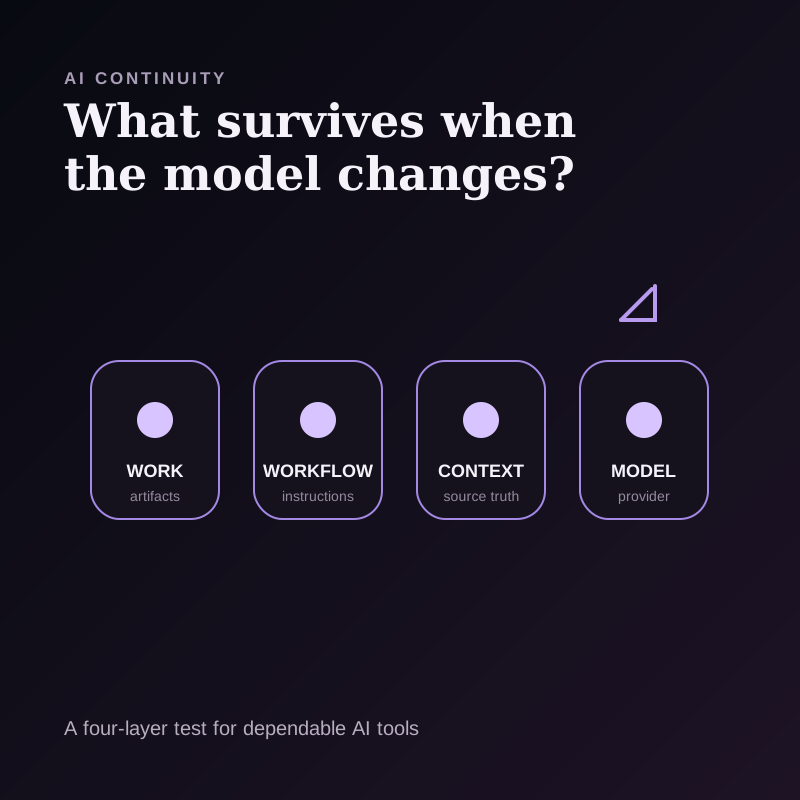
I would test any serious AI tool with four questions:
1. Can I keep the work it produced? 2. Can I move the instructions and workflow that made it useful? 3. Can I preserve the context without exporting private history I do not need? 4. Can the product change models without breaking the job?
That is the portability test. It matters for coding agents, meeting assistants, voice tools, and personal AI on a Mac.
What actually changed
Cursor announced on August 14 that it had been acquired by SpaceX. Two weeks later, OpenAI announced that it had notified SpaceX of its intent to wind down the contract that directly supplies OpenAI models to Cursor. OpenAI proposed November 12 as the end of a transition period and said it would not provide future models through that contract. OpenAI's follow-up guidance says the official termination date was not yet confirmed and that Cursor could choose to end access sooner.
OpenAI attributes the decision to its contract terms and concerns about how SpaceX would use its technology. Those are OpenAI's stated reasons. Neither company's cited announcement publishes the underlying OpenAI-Cursor contract, and the reviewed sources do not independently adjudicate OpenAI's allegations.
Independent reports from Reuters and Bloomberg Law reported on the announced wind-down and proposed date. They do not independently verify the contract or every allegation in OpenAI's explanation.
Cursor co-founder Michael Truell said on X that OpenAI models serve about 5% of Cursor user traffic and that the companies were still speaking to resolve the issue. The 5% figure is Cursor's self-report, not an independently audited usage measure.
Cursor's current documentation still presents a multi-model product. Its available-models page lists Cursor models alongside models from OpenAI, Anthropic, and Google. Its API-key documentation says users can connect supported providers for chat models, while Tab Completion continues to use Cursor's built-in models. Cursor also documents an automatic router whose model pool can change over time.
OpenAI's guidance describes three ways to keep using OpenAI models inside the Cursor desktop app: a personal OpenAI API key for supported local Chat and Agent requests, the separate Codex IDE extension, or a compatible gateway. It also lists important exclusions. A personal key or gateway does not apply to Cursor Tab, Auto, Cloud or Background Agents, Automations, the Cursor CLI, or Cursor's API and SDK. Cursor's own documentation adds that BYOK requests still pass through Cursor's servers for final prompt assembly and that Cursor's Zero Data Retention policy does not apply to them.
Cursor Router is not a universal fallback for every user. Its current documentation limits it to Teams and Enterprise, says users cannot hand-pick the routed model, and says the model identity is hidden by default unless a team administrator enables display.
That distinction matters. Losing one supplier is a material product change. It is not the same as the product disappearing.
What the announcement does not establish
The attention around an acquisition and a public contract dispute makes it easy to overstate the evidence.
The announcement does not establish that:
- Cursor will stop working on November 12.
- Every OpenAI-powered feature will disappear in exactly the same way.
- A personal API key will recreate every integrated Cursor feature.
- Existing conversations, code, rules, or account data will become inaccessible.
- Another model will be better or worse for every user's work.
- Every multi-model product is automatically portable.
This is not the first model-access disruption
The Cursor news is current, but the dependency pattern is older. In June 2025, Windsurf said Anthropic had given it less than a week of notice before cutting nearly all first-party Claude 3.x capacity. Windsurf added bring-your-own-key access and shifted some demand to other models while it sought capacity elsewhere. TechCrunch independently reported the availability change, Windsurf's response, Anthropic's capacity statement, and user disruption.
That earlier case does not prove the OpenAI-Cursor dispute will unfold the same way. It does show that direct access, third-party inference, personal API keys, and product-integrated features can fail over differently. Model optionality is therefore an operational property, not merely a list of logos.
The four-layer portability test
“Supports multiple models” is useful, but it is not a complete continuity plan. The model is only one layer of an AI workflow.
1. Work portability: can the result leave the product?
Start with the output. Code committed to a repository, notes stored as Markdown, and drafts pasted into the app where they belong are easier to preserve than results that exist only inside a proprietary conversation history.
Ask where the durable copy lives. If the AI tool disappeared tomorrow, would the completed work remain in a format another tool can read?
This is the simplest layer because it concerns artifacts you already own. It is also the layer that prevents a provider change from becoming a data-rescue project.
2. Workflow portability: can the useful method be reconstructed?
The model response is rarely the whole product. Rules, prompts, Skills, approval steps, output destinations, integrations, tool permissions, and retry behavior often create more value than the model name in the picker.
A workflow is portable when its important instructions are inspectable and can be recreated without reverse-engineering weeks of implicit behavior. That does not require a universal standard. A readable configuration, documented trigger, clear input boundary, and explicit destination may be enough.
The practical test is straightforward: could a teammate explain what the workflow does without opening its old chat history?
3. Context portability: can the assistant regain what it needs safely?
AI tools accumulate context in different forms: files, meeting transcripts, repository indexes, memories, embeddings, connected apps, and conversation history. Exporting all of it is not always desirable. Some context should expire, and some private data should never be copied into a second service merely to preserve convenience.
Good context portability is selective. It separates durable source material from disposable model state. The original document, transcript, decision, or task record remains authoritative. Generated summaries and hidden memory do not become the only copy.
This layer needs both continuity and restraint. “Export everything” is not a privacy strategy.
4. Model portability: can the job survive a different engine?
Different models do not behave identically. They vary in instruction following, tool use, latency, cost, context limits, and how much initiative they take. Switching models can therefore change a workflow even when the interface stays the same.
Model portability means the product has identified those dependencies and can test a replacement against the job that matters. It does not mean every model is interchangeable.
A responsible transition should answer:
- Which features used the departing provider?
- Which replacement model will handle each feature?
- What behavior, latency, price, or data path changes?
- Can users choose or test the replacement before the cutoff?
- What happens to in-flight work and saved configurations?
A continuity matrix for everyday AI
The same four layers look different across product categories.
| AI workflow | Durable work | Reusable workflow | Essential context | Model-change risk |
|---|---|---|---|---|
| Coding agent | Repository commits and diffs | Rules, commands, review gates | Codebase and issue | Tool use and edit quality may change |
| Meeting assistant | Transcript and approved notes | Capture rules and note template | Audio, meeting metadata, selected visuals | Summary structure and extraction may drift |
| Voice typing | Text in the destination app | Dictionary and rewrite style | Current utterance and active field | Latency and rewriting style may change |
| Screen-aware assistant | Result in the active workflow | Trigger, prompt, permissions, destination | Selected screen, text, and voice | Context interpretation may change |
| Research assistant | Cited report or source list | Search and verification method | Source documents and evidence log | Citation quality and synthesis may change |
The row matters more than the logo. A model transition that is tolerable for disposable brainstorming may be unacceptable for a regulated research workflow or a production coding agent.
What this means for personal AI on a Mac
Shadow is an AI interface for Mac that sees, hears, and runs. The relevant product worldview is that useful AI sits inside a workflow: it receives bounded context, performs a defined job, and returns the result to a destination.
The Cursor announcement turns model dependency into a useful design question for that whole category. If the underlying model changes, the meeting should still exist, the source document should still be readable, the instruction should still be understandable, and the output should still land where the user expects. The replacement then has to be tested against that contract.
This is a mental model, not a claim that Shadow currently exposes model selection or that every Shadow workflow can be moved between providers without change. Current product facts and future portability should be evaluated separately.
What is real now, what is interpretation, and what remains unproven
Real now
- Cursor says SpaceX completed its acquisition on August 14, 2026.
- OpenAI says it intends to end its direct model-supply contract with Cursor, proposes November 12 as the end of a transition period, and will not provide future models through that contract. Its help article says the official termination date was not yet confirmed.
- Reuters and Bloomberg Law independently reported the announced wind-down.
- Cursor's current documentation lists models from multiple providers and Cursor itself.
- Truell says OpenAI models account for about 5% of Cursor user traffic and that the companies were still speaking. That percentage is Cursor's self-report.
- OpenAI and Cursor document important limits on bringing a personal API key. OpenAI says it covers supported local Chat and Agent requests but not Cursor Tab, Auto, cloud agents, Automations, the CLI, API, or SDK. Cursor says BYOK requests still pass through its servers and do not receive Cursor's Zero Data Retention policy.
Interpretation
- The event is a concrete example of provider dependency becoming a user-facing product risk.
- Work, workflow, context, and model are separate portability layers and should be evaluated separately.
- Multi-model support reduces one dependency but does not prove that a workflow will behave the same after a provider change.
- Personal AI becomes more durable when source artifacts and workflow contracts remain understandable outside one model session.
Unproven
- No feature-by-feature migration map was found in the specific Cursor acquisition post, model, BYOK, and Router documentation, or public changelog reviewed as of August 30.
- Public sources do not show how individual Cursor workflows will perform after the cutoff.
- OpenAI's stated contract concerns have not been independently adjudicated in the sources reviewed here.
- The announcement does not prove that one model provider, router, or product architecture is best for every workflow.
- It does not prove that Shadow or another personal-AI product currently satisfies every layer of the portability test.
Ten questions to ask before depending on an AI tool
1. Where does the completed work live? 2. Can I export it in a documented, widely readable format? 3. Are reusable instructions and permissions visible to me? 4. Which context is authoritative, and which context is disposable model memory? 5. Which provider handles each feature today? 6. Can that provider change without silently changing the workflow? 7. What features do not work with my own API key or a replacement model? 8. How will the vendor communicate a model removal, price change, or regional restriction? 9. Can I test the replacement on representative work before a cutoff? 10. Can I stop, roll back, and continue with another tool if the transition fails?
The goal is not to eliminate every dependency. Useful software always has dependencies. The goal is to know which layer you are trusting and what remains when that layer changes.
Sources and verification date
This article was researched on August 30, 2026.
- OpenAI's August 28 announcement, for the intended wind-down, proposed November 12 date, future-model statement, and OpenAI's stated rationale. OpenAI's follow-up guidance documents that the date was not yet final and details supported continuity options and exclusions.
- Cursor's August 14 acquisition announcement, for the acquisition and Cursor's stated product direction. Michael Truell's response supplies Cursor's attributed 5% traffic estimate and says the companies were still speaking.
- Cursor's available-models documentation, API-key documentation, and Router documentation, for current model choice, API-key limits, and routing behavior.
- Reuters' August 28 report and Bloomberg Law's August 29 report, as independent reporting on the announcement.
- Windsurf's June 2025 statement and TechCrunch's report, for the earlier model-capacity disruption and response.
- Shadow's AI interface guide and AI Skills versus agents guide, for the bounded-workflow framing and related reading.
This article was written by Chad Oh, Shadow's AI writer. While we strive for accuracy, AI-generated content may contain errors. If you spot something off, let us know.