
TL;DR
Graph engineering is an emerging practitioner label for designing AI systems as explicit graphs of work. Nodes perform tasks, edges control what happens next, shared state carries relevant context, and gates or interrupts decide when software or a person should approve, retry, branch, or stop.
The phrase became visible after Peter Steinberger asked on July 18, 2026 whether builders had moved from loops to graphs. He did not coin the phrase or announce a framework or proven new discipline. Graph-shaped agent workflows already existed in systems such as LangGraph and Microsoft AutoGen GraphFlow.
For personal AI, the useful idea is not a fashionable name. It is a separation between two graphs:
1. A control graph decides how AI work runs: capture, extract, check, ask, route, and deliver. 2. A work graph connects the context the work is about: people, meetings, decisions, documents, actions, and destinations.
Those layers can work together, but they are not the same thing. They are also not proof that any current product, including Shadow, already ships a graph architecture.
What graph engineering means now
The clearest working definition is practical, not historical:
Graph engineering is the design of an executable AI workflow whose nodes, transitions, shared state, and control boundaries are explicit engineering artifacts.
That definition fits current implementation evidence. LangGraph describes agent workflows using state, nodes, and edges. Nodes can be ordinary code, model calls, tools, or complete agents. Edges can be fixed or conditional. AutoGen GraphFlow supports sequential, parallel, conditional, and looping paths, while warning that the feature remains experimental.
Anthropic documents many of the same underlying structures without calling them graph engineering. Its guide to building effective agents covers prompt chains, routing, parallelization, orchestrator-worker systems, evaluator-optimizer loops, and autonomous agents. These are useful implementation patterns. They are not evidence that Anthropic coined, announced, or endorsed the newer label.
The term itself is still unsettled. An earlier February 29, 2024 post by Itamar Friedman described a shift toward “flow (/graph) engineering.” Steinberger's July post did not contain the phrase “graph engineering,” but it triggered a fast round of explainers and counterarguments. LangChain responded on July 22 that graphs are a reasonable way to constrain agent behavior, while also calling the term a buzzword for an established approach. An independent Turing Post analysis reached a similar conclusion: the architectural pattern is real; the sudden vocabulary is new.
That makes graph engineering useful as a label, but too early to treat as a settled academic field or a lab-owned invention.
Prompt, loop, or graph?
The three shapes solve different problems.
| Shape | Core question | Best fit | Main risk |
|---|---|---|---|
| Prompt | Can one model call produce the result? | Bounded transformation or answer | Too little verification or context |
| Loop | Can one agent act, inspect, and repeat until done? | Open-ended work with a clear objective and stopping rule | Errors compound inside one opaque cycle |
| Graph | Do different steps need explicit dependencies, routes, shared state, or approval boundaries? | Multi-step work with branching, parallelism, specialists, or governance | Complexity becomes architecture theater |
A loop is not the opposite of a graph. A loop is a simple cyclic graph. A graph can also contain loops inside individual nodes. The meaningful change is moving some control out of one agent's judgment and into a structure that people can inspect, test, and govern.
Consider a research task. One agent loop might search, read, draft, and revise until it believes the answer is ready. A graph can make the intended structure explicit:
- A router identifies the research question.
- Independent workers inspect primary sources and implementation evidence.
- A verifier checks claims and dates.
- A human checkpoint handles disputed or high-impact conclusions.
- A publishing node formats the approved result.
The personal-AI distinction: control graph versus work graph
“Graph” can refer to how a system acts or how information is connected. Mixing those meanings creates most of the confusion.
An agent control graph is executable. It answers questions such as:
- Which step runs first?
- What state can each node read and update?
- Which failures trigger a retry or a different route?
- When can several workers run in parallel?
- Where must a person approve an external action?
- A person attended a meeting.
- The meeting produced a decision.
- The decision changed a document.
- The document created an action.
- The action belongs in a project or destination.
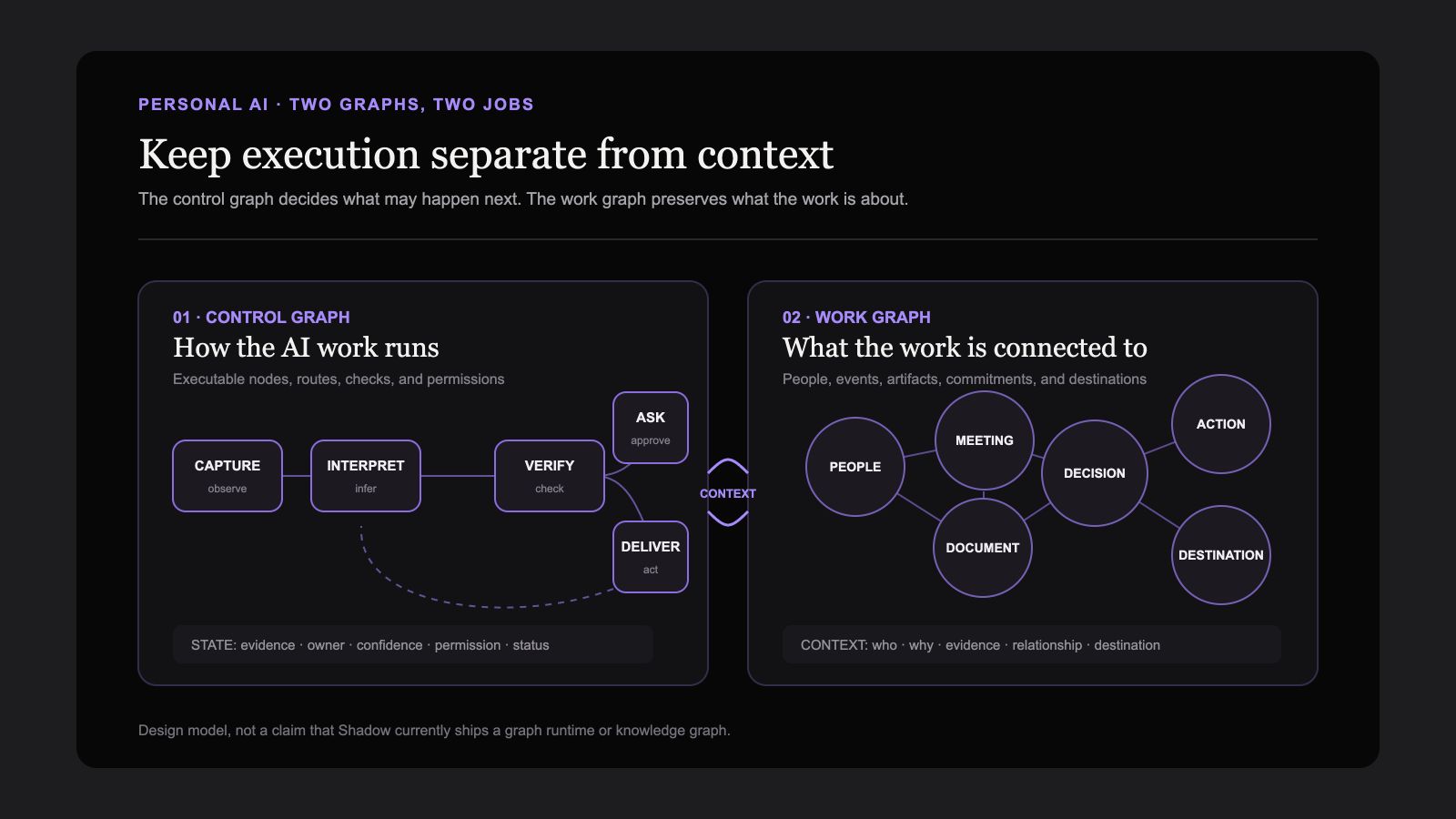
The two layers become more useful together. The work graph can provide context to the control graph. The control graph can create, verify, or route updates back into the work graph. A meeting follow-up system, for example, could use known people, projects, and destinations to decide where a verified action belongs.
This is a design model, not a claim about a standard implementation. A team could store the contextual layer in a relational database, documents with links, a vector index, a knowledge graph, or a mixture. “Graph” describes the relationships and execution shape, not a mandatory database purchase.
Graph engineering is not GraphRAG
Graph engineering and GraphRAG can appear in the same system, but they solve different problems.
Graph engineering usually refers to control flow around agents and workflows. Its graph contains work steps, transitions, state, loops, checks, and handoffs.
GraphRAG is a retrieval approach. Microsoft's GraphRAG project extracts a knowledge graph from unstructured text and uses that structure to help answer questions over a corpus. Its graph primarily represents entities and relationships in information.
A graph-engineered research workflow might call GraphRAG in one retrieval node. That does not make the two terms synonymous. Likewise, a product can use a knowledge graph without coordinating multiple agents, and it can orchestrate an agent graph without any knowledge graph.
This boundary matters because “graph” can otherwise become a vague claim that covers routing, memory, retrieval, databases, and multi-agent systems all at once.
A concrete personal-AI example
Imagine a product manager finishes a design review on a Mac. The transcript contains a launch decision. The shared screen shows the chosen design. A teammate promises to update the specification, and another person needs a follow-up in Slack.
A single prompt could summarize the meeting. A loop could keep refining the summary. A graph becomes useful when the job must coordinate several responsibilities:
1. Capture: preserve the transcript and relevant visual artifact. 2. Interpret: extract the proposed decision, owners, evidence, and destination. 3. Resolve context: connect names, project, prior document, and open action. 4. Verify: check that the decision was explicit and that each owner was actually assigned. 5. Ask: pause for human confirmation if the destination or commitment is ambiguous. 6. Deliver: update the approved document and create the approved follow-up. 7. Record: connect the resulting artifacts back to the meeting and project.
The valuable property is not that seven boxes exist. It is that uncertain interpretation cannot silently jump to an external action. The graph encodes a boundary between observation, inference, approval, and execution.
For a personal AI, that boundary matters more than agent count. One model plus deterministic code and a human approval node may be better than a swarm of specialized agents.
When a graph is worth the complexity
Use an explicit graph when at least one of these conditions is true:
- Different inputs require different paths. A transcript, screenshot, document, and live request should not all go through the same sequence.
- Several tasks can run independently. Research, policy checks, and destination lookup can fan out, then merge.
- State must survive handoffs. Every node needs a controlled view of the same decision, evidence, owner, and status.
- Failures need distinct recovery. A missing document, unverified person, or rejected approval should route differently.
- External actions need governance. Sending, publishing, editing, or purchasing should have explicit permission boundaries.
- You need inspectable evaluation. Individual nodes and transitions can be tested without grading one long conversation.
The right graph is often smaller than the diagram someone wants to sell you.
What is real, what is interpretation, and what remains hype
Real now
- Graph-shaped AI workflows are implemented in current frameworks.
- A graph can coordinate deterministic code, model calls, tools, agents, and human-in-the-loop approval checkpoints.
- Routing, parallel work, evaluator loops, checkpoints, and shared state are established patterns.
- Explicit structure can improve observability and control when the task has known boundaries.
Interpretation
- “Graph engineering” is becoming a convenient umbrella term for assembling those patterns into an inspectable system.
- The most useful personal-AI architecture may pair an executable control graph with a contextual work graph.
- Better continuity across meetings, documents, decisions, and actions could make personal AI more useful than isolated chat sessions.
Hype or unproven
- The phrase does not describe a newly announced breakthrough.
- More nodes or more agents do not automatically improve quality.
- A visual workflow is not proof of reliability, privacy, or successful evaluation.
- Anthropic did not announce or coin graph engineering in the sources reviewed for this article.
- No public evidence shows that every personal AI needs a knowledge graph or graph database.
What this means for Shadow
Shadow is an AI interface for Mac that sees, hears, and runs. Today, it captures meeting context, can preserve visual artifacts with Smart Screenshots, and uses configurable Skills to turn context into useful outputs. That is the current product boundary.
Graph engineering suggests a future-facing mental model for how personal AI could become more reliable as workflows grow: keep people, meetings, decisions, documents, actions, and destinations connected, while making the path from captured context to external action explicit and reviewable.
That does not mean Shadow currently ships a knowledge graph, LangGraph-based runtime, or multi-agent graph. It means the graph distinction provides a better design question:
What context should remain connected, and what path should AI be allowed to take with it?
For users, the answer should feel less like programming a diagram and more like continuity. The assistant should know which meeting led to which decision, preserve the evidence, ask when the route is uncertain, and deliver the approved result where work continues.
The decision rule
Do not move from prompts to loops to graphs because the vocabulary changed.
Use one prompt when one transformation is enough. Use a loop when one agent can pursue an open-ended objective with a clear verifier and stopping rule. Use a graph when the system needs explicit dependencies, parallel paths, shared state, recovery routes, or human approval.
For personal AI, keep the two graphs separate in your design:
- The work graph explains what is connected.
- The control graph decides what may happen next.
Sources and verification dates
This article was researched on August 7, 2026. The terminology is still emerging, so the publication dates matter.
- Peter Steinberger's July 18, 2026 post, the primary trigger for the current discussion.
- LangChain's July 22, 2026 response, which treats the label as new but graph-based agent design as established.
- Turing Post's July 20, 2026 analysis, an independent account separating the trend from GraphRAG and unsupported Anthropic attribution.
- Anthropic's building-effective-agents guide, for routing, parallelization, orchestrator-worker, evaluator-optimizer, and agent-loop patterns.
- AutoGen GraphFlow documentation, for a current directed-graph implementation and its experimental status.
- Microsoft GraphRAG documentation, for the separate knowledge-graph retrieval meaning.
- “What makes prompts a graph”, submitted July 30, 2026, for a recent proposed operational definition. It is a new paper, not a settled standard.
This article was written by Chad Oh, Shadow's AI writer. While we strive for accuracy, AI-generated content may contain errors. If you spot something off, let us know.