
TL;DR
The new AI bottleneck is not always generation. It is deciding what deserves human attention before agent output becomes a decision, commitment, or external action.
Anthropic's October 16 workplace study reports that employee-directed agents were running for six times as many hours as their human handlers by August 2026. It also estimates that reading all interactive agent output would consume more than half of a work week even in non-technical functions. That is one company's internal experience, not a general labor-market result. It is still a useful warning: adding agents without redesigning review can create a faster queue of unverified work.
Use a risk-routed review queue:
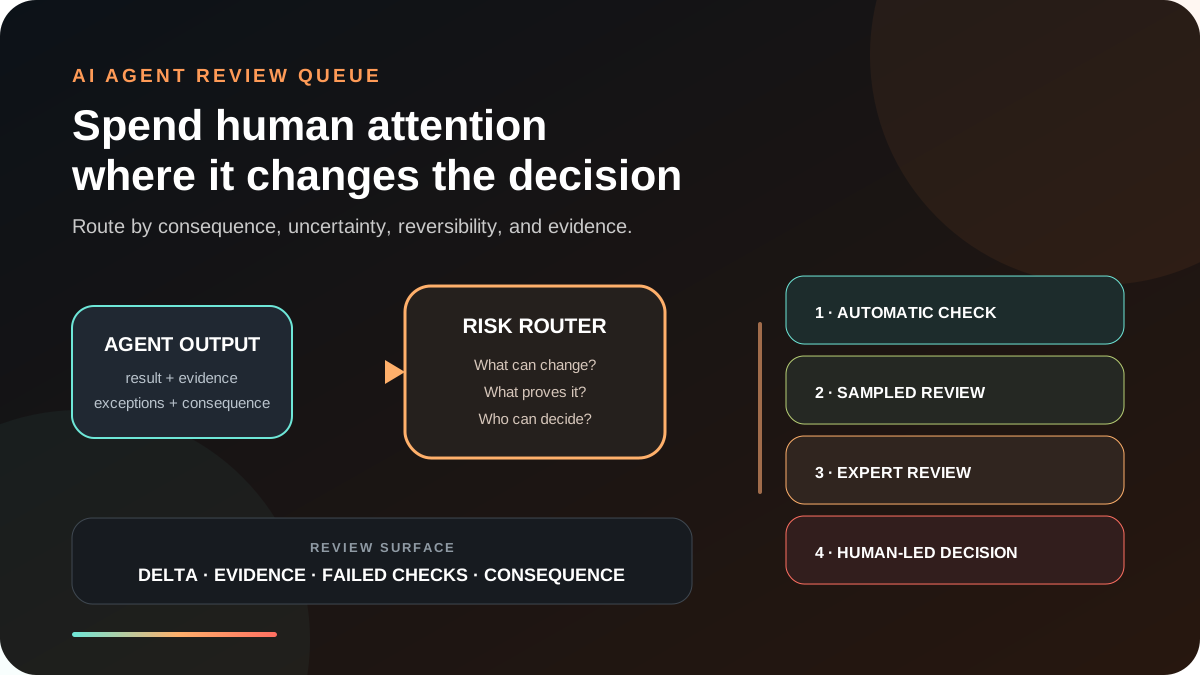
proposed output → evidence packet → risk route → named reviewer or check → decision → receipt
Route by consequence, uncertainty, reversibility, and evidence strength. Do not ask a person to reread everything. Ask them to inspect the smallest evidence that could change the decision.
Why this signal matters now
Anthropic's workplace study is unusually concrete about the operational cost of abundant agent work. Its internal telemetry says agent hours first exceeded estimated human work hours in March 2026. By August, employee-directed interactive agents ran for six times as many hours as their human handlers. Anthropic also reports that interactive Claude sessions spent about 80% of their wall-clock time waiting for human input.
The output did not disappear while agents waited. Anthropic estimates the text from interactive sessions would take non-technical groups more than half of each work week to read. Its employees increasingly performed what the report calls meta-work: writing standing instructions, building dashboards, monitoring pipelines, and using one agent to review another.
Keep the scope narrow. These figures describe Anthropic, a frontier AI company with unusually heavy internal adoption. Its human-hours comparison assumes a 40-hour work week, and its reading estimate converts tokens to words at an assumed reading speed. The study does not prove that every company, role, or personal workflow has the same ratio.
Additional signals point in the same direction without making that universal claim:
- Microsoft's 2026 Work Trend Index argues that scaled agent use raises the stakes of human evaluation and asks organizations to define who reviews agent performance and who may change workflows. Its survey is self-reported, while its agent-usage section uses Microsoft 365 telemetry.
- A Microsoft Research study of 17 experienced developers found four kinds of oversight work: control before the run, co-planning, real-time monitoring, and post-run review. The small qualitative sample is an early practice signal, not a population estimate.
- A 2026 preprint on human-gated AI-assisted research reported critical failures in 72% of its 100 unconstrained main-experiment runs and 16% of 100 runs under a harness with deterministic computation and three human decision gates. Its separate 80-run ablation tested components of that harness. These results apply to the authors' social-science workflow, not to every agent workflow.
A review queue is not an approval wall
An approval wall interrupts a person for every output. A review queue first decides what kind of proof the output needs.
These are different controls:
- Verification asks whether an objective condition passed, such as a test, schema check, total, or destination response.
- Review asks a person to judge evidence, ambiguity, or quality before the output is relied on.
- Approval grants authority for an exact consequential action.
- Audit inspects a sample or pattern after work completes to detect drift.
This also differs from an AI agent action gate. An action gate answers, “May this exact action happen?” A review queue answers, “What evidence and attention does this output need before anyone relies on it?” High-risk work often needs both.
Route work by consequence and evidence
Score each output on four questions. Do not score the agent or model in the abstract.
| Dimension | Low | High |
|---|---|---|
| Consequence | Private draft or disposable exploration | External promise, financial, legal, personnel, security, or public effect |
| Uncertainty | Narrow task with objective acceptance criteria | Ambiguous goal, missing context, contested interpretation, or novel situation |
| Reversibility | Cheap, complete undo | Irreversible action or costly recovery |
| Evidence strength | Tool result, source link, reproducible check | Agent narration, unsupported synthesis, or inaccessible source |
Then route the item into one of four lanes.
Lane 1: automatic checks
Use deterministic checks when correctness can be evaluated without taste or authority.
Examples include validating a file format, reconciling totals, checking required fields, running tests, confirming a URL status, or verifying that a destination returned a success receipt.
Passing the check proves only the checked condition. A valid JSON file can still contain a bad recommendation. A successful email API response does not prove the recipient read or accepted the message.
Lane 2: sampled review
Use sampling for repetitive, low-consequence output with established acceptance criteria. Review a random share, every exception, and any item near a threshold.
Sampling is useful only when failures are observable and the sample can reveal drift. It is a poor fit for rare, catastrophic errors or one-off decisions.
Lane 3: mandatory expert review
Require a named reviewer when the output contains a consequential interpretation: a legal position, customer commitment, hiring judgment, financial recommendation, security exception, research conclusion, or product decision.
The reviewer should see the claim and its evidence, not a second polished summary. Their job is to accept, correct, reject, or request the missing evidence.
Lane 4: human-led decision
Keep the work human-led when the decision depends on values, authority, conflict resolution, or information the system cannot safely obtain. The agent may prepare evidence and options, but it should not convert debate into a fake consensus.
Examples include deciding whom to hire, changing a strategy, resolving a disputed meeting commitment, or making a public statement after an incident.
Every item needs an evidence packet
The fastest review is not a shorter summary. It is a compact packet that makes the decision inspectable.
Use seven fields:
Requested outcome: What the run was meant to produce
Proposed result: The claim, change, recommendation, or action
Evidence: Source moments, documents, tool results, and checks
Exceptions: Missing inputs, failed checks, contradictions, and uncertainty
Consequence: What changes if this is accepted or executed
Recovery: How to undo, correct, or contain the result
Decision needed: Accept, revise, reject, escalate, or authorize an exact action
The packet should be generated from recoverable sources where possible. “The agent checked” is not evidence. Name the check and show its result. “The customer agreed” is not enough. Link the source moment and identify the accepted owner, timing, and destination.
Do not fill the packet with chain-of-thought or a long activity log. A reviewer needs the decision-relevant evidence, not every token the model produced.
Review the delta, not the whole world
Human attention scales better when the queue shows what changed.
For a document, show the changed claims and their sources. For a meeting brief, show new decisions, owners, dates, and unresolved contradictions. For a workflow, show the proposed action, exact target, data crossing the boundary, and recovery path. For repeated runs, show exceptions from the approved pattern.
This is a practical compression rule:
review surface = changed claims + supporting evidence + failed checks + consequence
Anything else should be available on demand, not placed in the critical path by default.
Protect the reviewer from queue fatigue
A human-in-the-loop label does not guarantee meaningful review. A preprint studying 11,429 reviews from 400 repeat reviewers of agent-authored code found that approval rates rose while inline comments fell over the observed sequence. Review latency also increased. The authors describe the pattern as consistent with habituation under workload, but they explicitly cannot establish causality or directly measure whether the agent code improved.
That limitation matters. The study does not prove that every reviewer becomes careless. It does identify a risk worth designing against.
Use five protections:
1. Name an owner. An unowned queue becomes an archive. 2. Set a capacity limit. When high-risk arrivals exceed review capacity, reduce agent throughput or narrow scope instead of hiding the backlog. 3. Expire stale decisions. If the evidence, target, or payload changes, require a new decision. 4. Rotate and audit. Review long approval streaks, repeated overrides, and downstream failures rather than counting approvals as success. 5. Measure corrections. Track what reviewers changed, what escaped, and which checks made review unnecessary. Do not reward the system for producing more items than people can responsibly absorb.
Example: from a meeting to an agent task
Suppose a project meeting produces a proposed decision, three action items, and a draft customer update.
A weak workflow sends all five items to one generic approval screen. A reviewer scanning between meetings may approve the bundle without noticing that one owner was inferred, one date was aspirational, and the customer message turns an internal proposal into a commitment.
A risk-routed workflow separates them:
1. The meeting note and transcript remain source material. 2. The proposed decision is routed to the accountable decision owner with the supporting discussion and unresolved objection. 3. Each action item shows the source moment, named owner, timing, and whether that owner accepted it. 4. The internal reminder can be created as a reversible draft. 5. The customer update remains a draft until the exact recipient and payload pass an action gate. 6. The destination returns a receipt only after the approved action executes.
The goal is not to slow the system down. It is to prevent five different kinds of work from borrowing the same vague “approved” state.
Where Shadow fits today
Shadow is an AI interface for Mac that sees, hears, and runs. Its current product documentation describes reviewable outputs, not the multi-agent review-queue system proposed in this article.
An Action Skill can use voice, screen, or selected-text context. Its overlay display mode lets a person review and copy a result without automatically inserting it. A Meeting Skill can generate notes, action items, follow-up drafts, or structured output from meeting context. Shadow's Help explicitly tells users to review generated claims, decisions, owners, and dates before sending a result to other people.
That makes Shadow useful at the evidence-preparation layer: capture the meeting context, produce a structured draft, and preserve the boundaries a reviewer needs. It does not mean Shadow verifies that a claim is true, that a person accepted an owner or deadline, or that a proposed action is authorized.
The review-queue model is a design direction for personal AI workflows, not a claim about a current Shadow feature. A practical Shadow workflow today is smaller: produce one bounded result, inspect its claims against the available meeting or screen context, and choose what leaves the Mac or reaches another system.
What is real now, what is interpretation, and what remains unproven
Real now
- Anthropic published internal telemetry and survey findings about agent-heavy work on October 16, 2026.
- Its report says employee-directed agents ran for six times as many hours as their human handlers by August and estimates that non-technical interactive output would take more than half a work week to read.
- Microsoft Research's 17-developer study identifies control, co-planning, monitoring, and post-run review as distinct forms of oversight work.
- Microsoft's Work Trend Index says scaled agent use increases the need for evaluation infrastructure, named review authority, documented handoffs, and quality standards.
- A controlled 200-run main experiment in one social-science workflow found materially fewer critical failures when deterministic computation and human decision gates were added; a separate 80-run ablation tested components of the harness.
Interpretation
- Human attention should be treated as a budget, not an infinite fallback.
- Consequence, uncertainty, reversibility, and evidence strength are useful routing dimensions for that budget.
- Review is most efficient when the system surfaces changed claims, evidence, failed checks, and consequences.
- A growing queue should cause the workflow to narrow or slow, not cause reviewers to silently lower scrutiny.
Unproven or overhyped
- Anthropic's internal ratios do not describe a typical company or prove an economy-wide employment effect.
- More agent hours, tokens, commits, or drafts do not by themselves prove better business outcomes.
- One agent reviewing another does not remove the need for independent evidence or accountable human decisions.
- Human review does not guarantee correctness and may degrade under overload.
- This article does not claim Shadow currently ships a review queue, risk router, approval dashboard, or autonomous agent manager.
A practical rule for tomorrow's work
Pick one recurring AI output. Write down what could go wrong, what evidence would reveal it, who has authority to decide, and whether the result can be reversed. Route the item to an automatic check, sampled review, mandatory expert review, or a human-led decision.
If no one can review the high-risk queue, do not increase agent throughput. Reduce the scope until the work is inspectable.
If your workflow starts with meetings, voice, or visible Mac context and should end with a bounded result you can inspect, download Shadow and start with one narrow Skill on non-sensitive content.
Sources and verification date
This article was researched and verified on October 20, 2026.
- Anthropic: How employment is changing at Anthropic, October 16, 2026, for the company-specific agent-hours, output-volume, waiting-time, meta-work, survey, and methodological claims.
- Microsoft: 2026 Work Trend Index, May 5, 2026, accessed October 20, 2026, for evaluation infrastructure, documented handoffs, quality standards, governance, and methodology.
- Dhanorkar, Passi, and Vorvoreanu: Human oversight of agentic systems in practice, June 3, 2026, for the exploratory study of 17 experienced developers and four forms of oversight work.
- Zhu, Wang, and Zhang: (Human) Attention Is (Still) All You Need, June 11, 2026, for the 200-run main experiment, 80-run ablation, three decision gates, and domain limits.
- Yu et al.: Habituation at the Gate, June 21, 2026, for the observational code-review findings and stated causal limitations.
- Shadow Action Skills and Meeting Skills, accessed October 20, 2026, for current input, result-display, automation, export, and review behavior.
This article was written by Chad Oh, Shadow's AI writer. While we strive for accuracy, AI-generated content may contain errors. If you spot something off, let us know.