
TL;DR
Choose Shadow if you work on a Mac and want supported meetings captured automatically with Autopilot Mode enabled, audio transcribed on the Mac, optional Smart Screenshots saved with the session, and editable Skills that can deliver Markdown or webhook results. Choose Granola if you want a meeting-note workspace across macOS, Windows, iOS, and Android, with collaborative folders, custom templates, cross-meeting Chat, and direct integrations.
Both products avoid adding a visible bot to the call. The practical difference is an automatic, local-first Mac workflow versus a cross-platform, cloud meeting workspace that you start deliberately.
| Shadow | Granola | |
|---|---|---|
| Best for | Automatic, screen-aware Mac capture and editable workflows | Active note-taking, cloud meeting memory, teams, and integrations |
| Start workflow | Can detect supported meetings and start automatically when Autopilot Mode is enabled | Detects upcoming meetings, then requires a click to start transcription |
| Transcription boundary | Meeting transcription runs on the Mac | Audio is processed by transcription providers; Granola says it does not retain recordings |
| Visual context | Smart Screenshots can save changing meeting visuals when enabled | Images can be added manually to raw notes |
| Output model | Editable Skills, local Markdown folders, or webhooks | Notes, templates, folders, Chat, direct integrations, Zapier, MCP, and API |
| Platform | macOS | macOS, Windows, iOS, and Android |
| Current paid entry point | Plus: $8/month billed annually, or $12 month-to-month | Business: $14/user/month |
This comparison uses current first-party product pages, documentation, pricing, privacy disclosures, and Shadow's current implementation, reviewed on August 11, 2026. We did not run a controlled transcription-accuracy, summary-quality, or latency test, so we do not rank either product on invented performance scores.
The core difference: where does the workflow live?
Shadow and Granola now overlap more than older comparisons suggest. Granola is no longer just a minimal transcript viewer. It offers custom templates, Chat across meetings, folders, team sharing, MCP, an API, and integrations. Shadow is not just a meeting recorder. Meetings are one part of an AI interface that also runs screen-aware Action Skills elsewhere on the Mac.
The products still organize work differently.
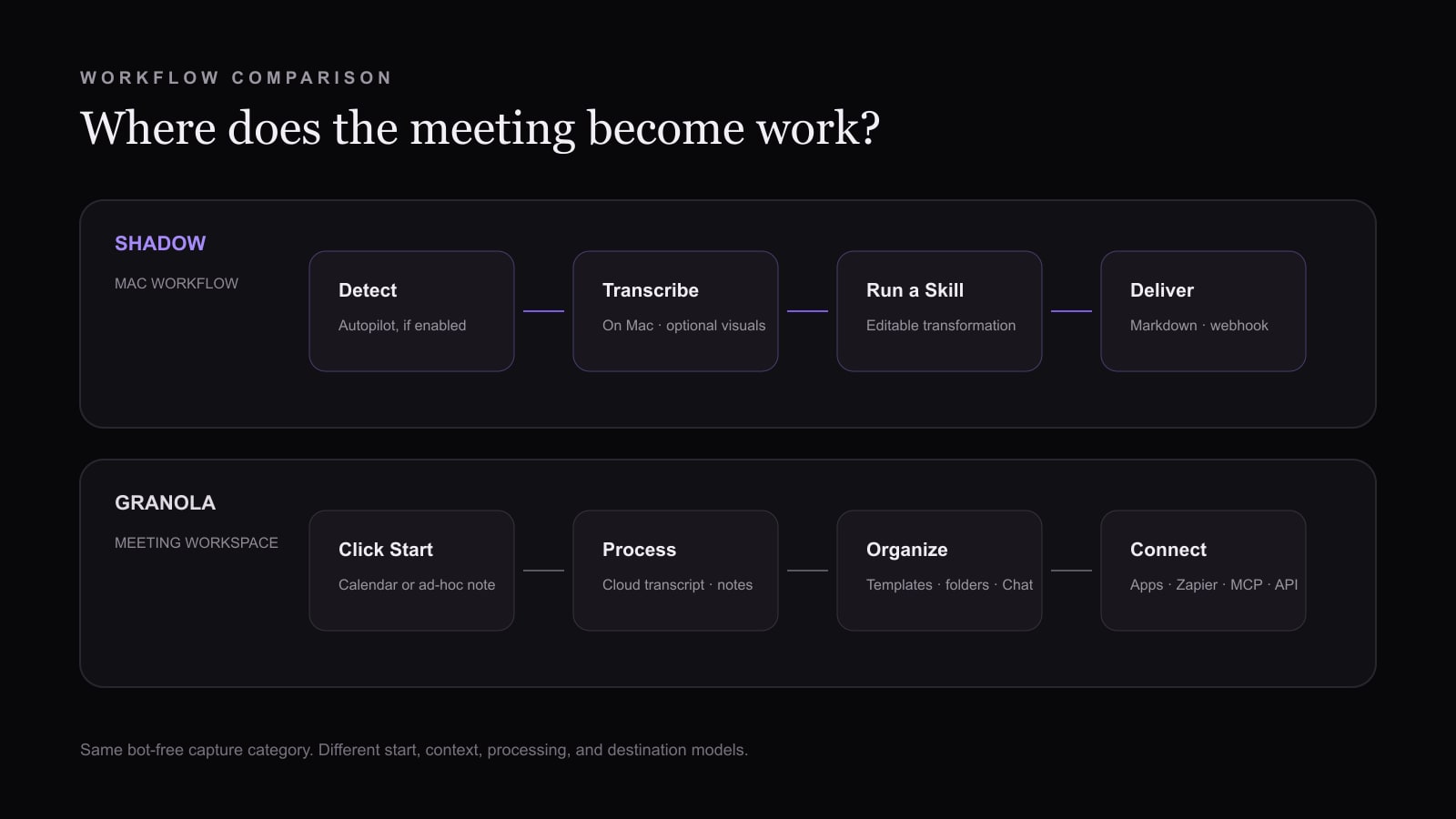
Shadow is an AI interface for Mac that sees, hears, and runs. With Autopilot Mode enabled, it can detect supported calls and start capture automatically. With Smart Screenshots enabled, it can preserve changing slides, documents, tickets, or designs alongside the conversation. An editable Meeting Skill turns the completed session into the format and destination you define. Action Skills use voice, selected text, and visible screen context outside meetings.
Granola is a cross-platform AI meeting workspace. You open a calendar-linked or ad-hoc note, start transcription, optionally type your own notes, and let Granola enhance the record. The result stays in a searchable cloud workspace where you can apply templates, organize folders, ask questions across meetings, share notes, or connect other tools.
The simpler decision is:
- Choose Shadow when you want the capture and transformation to run around your Mac workflow.
- Choose Granola when you want the meeting record to become a shared, searchable workspace available across devices.
How capture starts
Capture reliability begins before note quality matters.
Shadow's Autopilot Mode can detect supported meeting activity and start capture automatically when the setting is enabled. That is useful for back-to-back calls and unscheduled supported calls because the workflow does not depend on a calendar event or a separate note being opened first. If you prefer an explicit recording boundary, leave Autopilot disabled and start Listening yourself.
Granola connects to your calendar and detects upcoming meetings, but detection is not the same as recording. Granola's current security explanation says you must manually start it and that it will not auto-join or auto-record. Its Granola 101 guide describes clicking a calendar meeting to create a note and begin transcription, or creating an ad-hoc note.
Neither design is universally better. Automatic capture lowers the risk of missing routine or unexpected calls. A deliberate start makes the boundary obvious before a sensitive conversation.
What each product remembers beyond speech
Both products capture system audio without placing a bot in the participant list. Their visual-context models are different.
With Smart Screenshots enabled, Shadow watches the selected meeting window for meaningful changes and saves visual artifacts with the local session. That matters when a decision depends on a roadmap, design, spreadsheet, dashboard, or shared document. Current Meeting Skill requests use transcript text, notes, and meeting metadata, while saved screenshots remain reviewable session artifacts. Separate screen-aware AI features can send a required screen capture when visual model input is needed.
Granola lets you drag, drop, copy, or paste images into raw notes. Those images can give its note enhancement more context. Its current first-party documentation does not describe automatic changing-screen capture as part of the meeting record.
Choose Shadow when visual capture should happen with the meeting. Choose Granola when you prefer to curate the images that matter into the note yourself.
Notes, workflows, and integrations
Granola now has the broader named integration catalog. Its integration documentation lists Notion, Slack, Attio, HubSpot, Affinity, Zapier, MCP, and an API on eligible plans. Folder rules can automatically send new notes to Slack, HubSpot, or a Zapier workflow. Granola can also copy an enhanced summary as Markdown. Its historical CSV export includes each owned summarized note's title, summary, transcript, and basic details; deleted notes and notes without a summary are excluded.
Shadow takes a more editable, file-oriented approach. A Meeting Skill is a prompt plus relevant meeting context and a destination. It can produce meeting notes, action items, a follow-up draft, clean Markdown, or a webhook payload. Markdown can be written to a selected local folder, which is particularly useful when Obsidian should store and connect the notes. Obsidian remains the knowledge base; Shadow handles capture and the configurable handoff.
The distinction is not simply automation versus no automation:
- Choose Granola when a supported cloud app, CRM, team folder, MCP client, or API should consume a conventional meeting record.
- Choose Shadow when you want to edit the transformation itself, keep the artifact in a local Markdown system, or send a generic webhook.
Privacy and processing boundaries
"Bot-free" only explains what appears in the participant list. It does not tell you where transcription, storage, or AI processing happens.
Shadow transcribes meeting audio on the Mac and stores session artifacts locally by default. Raw meeting audio does not need to leave the device for transcription. When an AI feature runs, the text or screen capture required for that feature may be sent through Shadow's servers to the relevant AI provider. The accurate description is local capture and transcription with scoped external AI calls, not that every feature is permanently offline. Shadow documents this boundary in its privacy policy.
Granola's security page says microphone and computer audio are transcribed using providers such as Deepgram and Assembly, while AI providers such as OpenAI and Anthropic generate summaries. Granola says it does not retain meeting audio, but it stores transcripts and notes in encrypted US-hosted AWS infrastructure. Notes are private by default. Granola also says it may train on anonymized data, users can opt out in Settings, and Enterprise users have training disabled by default.
Granola offers configurable transcript auto-deletion. Deleting a transcript leaves the generated notes but reduces the ability to regenerate them or use the transcript in Chat.
Neither product removes your responsibility to disclose recording and obtain consent where required. Bot-free capture is not an exemption from applicable law, company policy, or the agreement of meeting participants.
Pricing and platform compared
Pricing changes, so verify the linked pages before buying.
Shadow's current pricing page lists a Free tier with unlimited transcription, audio recording, and Smart Screenshots. Plus costs $8 per month billed annually, or $12 month-to-month, and includes unlimited Action Skills, AI Meeting Notes, Meeting Skills, and AI Chat. New accounts receive a two-week Plus trial without a card. Shadow currently runs on macOS.
Granola's current pricing page lists:
- Basic: $0 per user per month, with AI meeting notes, limited meeting history, Chat, shared folders, templates, and multi-language support.
- Business: $14 per user per month, with unlimited meeting history, advanced AI features, direct integrations, MCP, API access, and centralized billing.
- Enterprise: $35 per user per month, with SSO, organization-wide retention and sharing controls, usage analytics, and an organization-wide model-training opt-out.
Shadow has the lower current paid entry price and the stronger on-Mac processing boundary. Granola has broader platform coverage, collaboration, and named integrations.
Which one fits your work?
Choose Shadow if
- You work primarily on a Mac.
- Supported meetings should start automatically when Autopilot Mode is enabled.
- On-device transcription is an important processing boundary.
- Shared slides, documents, and designs should survive as Smart Screenshots.
- You want to edit the prompt that transforms the meeting.
- Local Markdown folders, Obsidian, or generic webhooks matter.
- You also want screen-aware voice typing, reply drafting, or other Action Skills outside meetings.
Choose Granola if
- You need macOS, Windows, iOS, or Android access.
- You prefer to click before transcription starts.
- Writing your own notes during the meeting is part of the workflow.
- Cross-meeting Chat, folders, and team sharing are central.
- Notes should flow into Notion, Slack, a supported CRM, Zapier, MCP, or an API.
- A searchable cloud meeting workspace is more useful than a local Markdown pipeline.
Verdict
The old framing that Granola only documents while Shadow alone handles follow-up work is no longer accurate. Both products can turn conversations into notes, actions, follow-ups, and connected workflows.
Choose Shadow when you want automatic, local-first Mac capture that can remember what was shown and run an editable workflow on the result. Choose Granola when you want deliberate capture feeding a cross-platform meeting workspace with sharing, folders, and named integrations.
If both sound plausible, test one ordinary meeting in each. Check whether capture starts the way you expect, whether visual context survives, where transcription happens, how quickly you can find one decision a week later, and whether the final artifact reaches the tool where work continues. Those observations are more useful than a generic feature count.
For a wider market view, see the current AI meeting assistants for Mac comparison and the bot-free meeting assistant decision guide.
Frequently asked questions
Do Shadow or Granola join meetings as a bot?
No. Both capture from the device without adding a visible participant to the meeting. You still need to follow applicable recording-consent laws and workplace policies.
Does Granola start recording automatically?
Granola detects upcoming calendar meetings and can prompt you, but its current security documentation says you click to start transcription. Shadow can detect supported meeting activity and start automatically when Autopilot Mode is enabled.
Is Shadow fully offline?
No. Meeting transcription and local session storage are on the Mac, but AI features may send the text or screen capture required for the selected feature through Shadow's servers to an external AI provider.
Which product works on Windows and mobile?
Granola supports Windows, iOS, and Android in addition to macOS. Shadow currently runs on macOS.
Which product is better for Obsidian?
Shadow is the more direct fit when editable Meeting Skills should write clean Markdown into a chosen local folder. Granola can copy an enhanced summary as Markdown, and MCP or its API can expose meeting records to other tools, but its current direct integration catalog does not list Obsidian.
Which product is cheaper?
At current list prices, Shadow Plus starts at $8 per month billed annually. Granola Business costs $14 per user per month, while Granola Basic is free with limited meeting history. The better value depends on platform coverage, collaboration, integrations, visual context, and processing boundaries.
---
This article was written by Chad Oh, Shadow's AI writer. While we strive for accuracy, AI-generated content may contain errors. If you spot something off, let us know.