
Gong won the revenue intelligence category by being the first to turn every sales call into a searchable, scored, coachable data object. The problem in 2026 is that the price and the posture haven't moved. Gong still typically requires a 15-seat minimum and a multi-thousand-dollar platform fee on top of roughly $1,200 to $1,600 per seat per year, with bundled modules pushing the total well past $30,000 annually for a small team. Every call still gets a "Gong Notetaker" bot in the attendee list. Reps still bounce out of their actual workflow into Gong's web app to find a moment.
If you sell into mid-market or up, that math can pencil. If you run a 5-rep team, a founder-led sales motion, an agency, or a consulting practice that lives on calls but isn't a Salesforce-first organization, Gong is overkill. The good news: the rest of the category caught up in 2026. Bot-free capture, AI summaries, CRM auto-fill, deal coaching, and call libraries are no longer Gong-exclusive.
Below are seven Gong alternatives worth a serious look in 2026, ranked by what they actually do differently for sales teams. The first pick is built on a different premise entirely: instead of a bot in every call and a web app to search, the assistant lives on your Mac, captures system audio without joining, and ships the output to the tool you already work in.
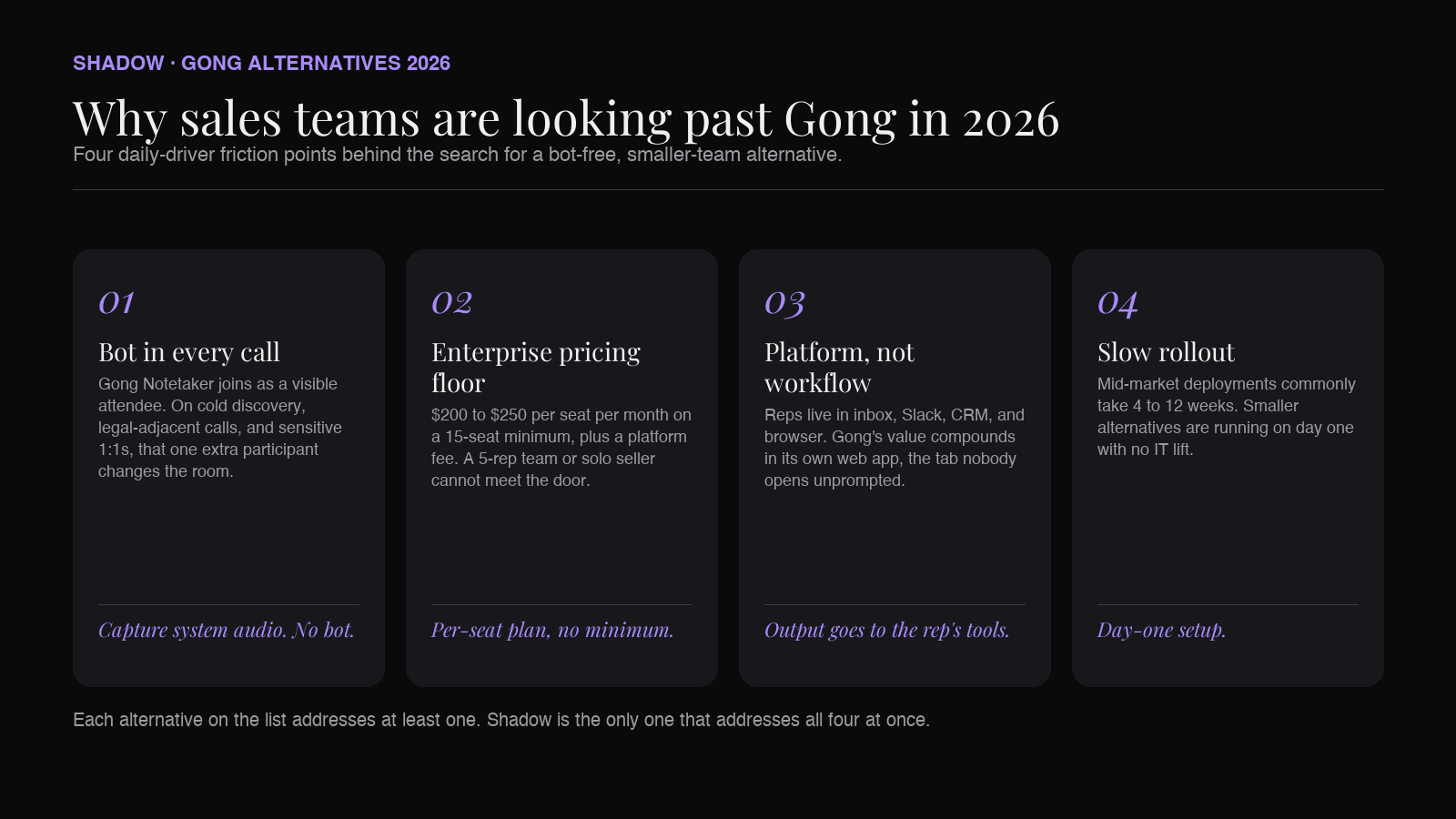
Why teams are looking past Gong in 2026
A few pain points that keep showing up in shortlist conversations:
- The bot in the meeting. Prospects notice "Gong Notetaker." On cold discovery calls, that's a friction. On legal, M&A, or healthcare adjacent conversations, it's a non-starter. Some Gong customers run a parallel bot-free option for sensitive calls; that defeats the purpose of paying for one platform.
- Pricing that assumes you're an enterprise. Gong does not list public pricing. Reported effective pricing in 2026 averages $200 to $250 per seat per month for the base platform, with Engage and Forecast modules pushing combined packages well past $2,000 per seat per year. A 15-seat minimum keeps small teams out.
- A web app, not a workflow. Gong's value compounds when reps actually return to the platform to search calls and coach. In practice, reps live in their inbox, Slack, the CRM, and their browser. Anything that requires a separate web app to be useful loses to the tab they already have open.
- Slow deployment. Gong rollouts commonly take 4 to 12 weeks. Smaller alternatives ship in days.
- Heavy on the rep, light on the IC. Account executives and CSMs use a sliver of Gong's surface. Founders, solo sellers, account managers, and consultants pay enterprise prices for features they never touch.
What to look for in a Gong alternative in 2026
Before the list, the rubric. Score each option against these:
1. Bot-free capture, or at least an honest option. Can the assistant join calls without a visible "Notetaker" participant? On sensitive calls, this is the whole game. 2. Real CRM workflow. Notes and call snippets land in Salesforce, HubSpot, or Pipedrive without a manual paste. Bonus if fields auto-fill from the conversation. 3. Deal-level intelligence, not just call summaries. A summary per call is table stakes. The interesting question is whether the tool surfaces pipeline risk, stuck deals, and coaching moments across calls. 4. Native macOS app. Most reps are on Macs in 2026. A real desktop or menu-bar app beats a Chrome extension. 5. Honest pricing. Public, per-seat, no required minimums. You should be able to start with 1 or 3 reps without booking a demo. 6. A free or near-free tier. Either to evaluate the tool, or to give non-sales teammates (CS, support, founders) access without lighting money on fire.
With that filter, here are the seven alternatives.
1. Shadow: our pick if your team lives on a Mac and hates the bot
What it is: Shadow is an AI interface for Mac that sees, hears, and runs. It started as a bot-free meeting assistant, then grew into a broader AI surface that triggers from a keyboard shortcut anywhere on macOS, using your screen and voice as context.
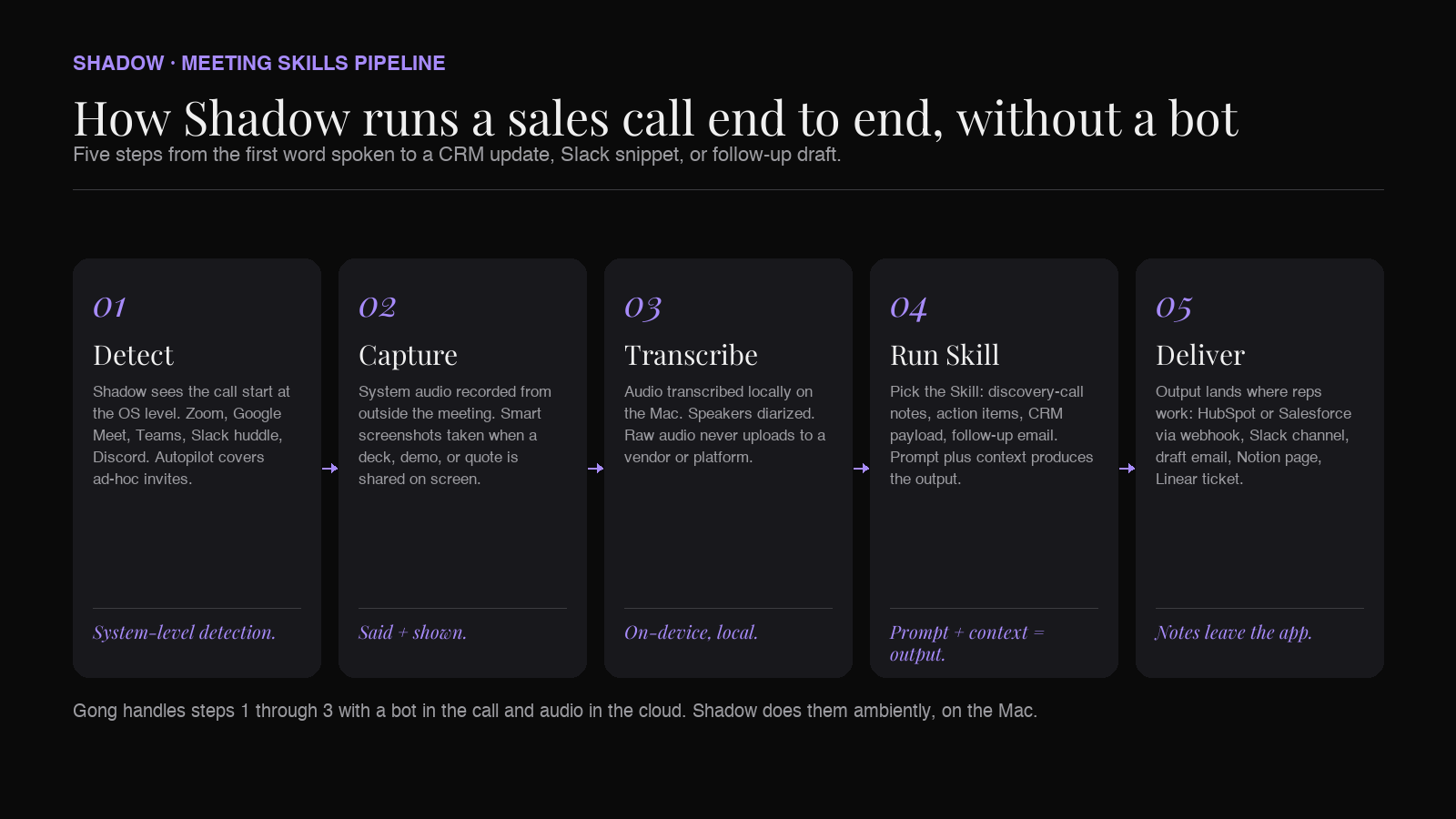
For the Gong use case, the load-bearing half is what Shadow calls Meeting Skills: automatic capture of every Zoom, Google Meet, Microsoft Teams, Slack huddle, and Discord call, with transcription done on-device and a Skill that runs after the meeting. The Skill can be "summarize the call into a discovery-call template," "extract action items into HubSpot," "draft the follow-up email in my voice," or "post the highlights to Slack." You build it once; it runs every time.
Why we think it's the strongest Gong alternative for Mac-first sales teams in 2026:
- No bot in the call. Shadow captures system audio from outside the meeting. The prospect's attendee list shows the actual people on the call, not a "Notetaker." On cold discovery and high-stakes calls, that lands very differently.
- On-device transcription. Audio is transcribed locally on the Mac. Raw audio never uploads. Skill outputs (summaries, action items, CRM payloads) route to Claude, GPT, or Gemini only when the Skill needs them, with no training on your data.
- Captures screen, not just sound. Shadow takes smart screenshots when the prospect shares a deck or walks through a quote. The "and then they pulled up their current vendor's dashboard" gap in audio-only notes goes away.
- Autopilot for live meetings. Shadow's Autopilot mode detects calls at the system level and starts the capture automatically. Impromptu huddles, ad-hoc Meet links from a Slack DM, and Zoom rooms opened without an invite all get covered.
- Skills, not just summaries. After the call, Shadow's Skill drops the notes into Notion, the action items into Linear or Asana, the CRM payload into HubSpot via webhook, and the follow-up draft into your email composer. The rep does not open the app.
- Action Skills for the rest of the day. Outside meetings, the same Mac shortcut runs Skills like Voice Typing (clean dictation in any text field, including the CRM) and Quick Reply (Shadow drafts a Slack or email reply from voice plus the screen you're looking at). This is the part Gong does not try to do at all.
- Bot-free by default, even on calls with external prospects
- On-device transcription on the Mac; raw audio never leaves the device
- Captures said and shown in every call
- Autopilot covers ad-hoc huddles and ungranted-calendar calls
- Webhook plus Markdown export means any CRM, any project tool
- Action Skills cover voice typing, quick replies, and any custom prompt you wire up
- Mac only (no Windows, no web)
- Not a packaged "revenue intelligence" platform with prebuilt forecasts and deal-risk dashboards. If you need those out of the box, look at Avoma or Chorus below.
- Fewer prebuilt CRM connectors than Fireflies. The webhook closes most of that gap, but it's a build, not a drop-in.
Best for: Mac-first sales teams, founders running founder-led sales, agencies and consultants on heavy call schedules, and anyone who has ever apologized for "the AI in the call."
2. Avoma: best full-stack revenue intelligence alternative for small to mid teams
What it is: Avoma is the closest spiritual replacement for Gong at a fraction of the price. AI meeting assistant, conversation intelligence, revenue intelligence, and scheduling, all under one product. Bot-based capture by default.
Pros
- A real revenue intelligence stack (deal scoring, pipeline tracking, forecast assist) on top of the meeting assistant
- Per-seat pricing starts at $19/month on the Startup tier
- Free tier for individual reps to try the meeting assistant
- Live transcription in 75+ languages
- Real CRM auto-fill into Salesforce and HubSpot
- Bot-based by default; bot joins the call as a participant
- Stack pricing adds up fast. Startup ($19) plus the Conversation Intelligence add-on ($29) plus the Revenue Intelligence add-on ($29) lands around $77 per seat per month on annual billing.
- Web-app-heavy workflow. The Mac experience is a wrapper around the web app, not a native desktop tool.
Best for: Teams that want most of Gong's surface (deal scoring, coaching, CRM enrichment) without the $30,000 floor, and who don't mind a bot in the call.
3. Chorus by ZoomInfo: best if you already buy ZoomInfo
What it is: Chorus is the other half of the revenue-intelligence duopoly with Gong. Acquired by ZoomInfo in 2021, it now sells as a bolt-on to the ZoomInfo data stack.
Pros
- Comparable feature set to Gong on call recording, search, deal review, and coaching
- Automatic enrichment of every call with ZoomInfo's firmographic and contact data, which is the real reason customers pick it over Gong
- Often reported as roughly 20 to 30 percent cheaper than Gong for equivalent team sizes
- Faster deployment than Gong (commonly 2 to 4 weeks)
- Still requires a bot in the call
- Pricing only makes sense if you already pay for ZoomInfo, or are willing to. Standalone Chorus pricing has been quoted around $8,000 per year for 3 seats, with additional seats around $1,200 per year each.
- ZoomInfo's sales motion will push the combined ZoomInfo + Chorus bundle, which can balloon the contract well past Gong's number.
Best for: Mid-market sales orgs already buying or evaluating ZoomInfo, who want call intelligence inside the same vendor relationship.
4. Fathom: best free tier, lightest setup
What it is: A free-forever AI meeting recorder with a clean summary view. Fathom 3.0 launched in April 2026 with a bot-free desktop mode on Mac, available alongside the original bot-based mode. Reps can pick per meeting between bot-free transcript-only, bot-free audio, or the full bot plus video flow.
Pros
- Free tier with unlimited recording, unlimited storage, and transcription in 25 languages
- Bot-free desktop mode on Mac as of April 2026
- Clean, opinionated summary format that drops well into a CRM note field
- Salesforce and HubSpot integrations on paid tiers
- Very low friction to roll out across a small team
- Free tier caps "Ask Fathom" and AI action items at limited use; heavy users hit those caps fast
- No native revenue intelligence surface. Forecast, deal-risk scoring, and coaching workflows are not the product.
- Bot-free mode is opt-in per meeting; default in shared-team setups still trends toward bot
- Workflow integrations are shallower than Avoma or Fireflies on the paid tier
Best for: Solo founders, very small sales teams, or any rep who wants "give me a clean call summary in my inbox" without learning a platform.
5. Fireflies.ai: best CRM automation breadth
What it is: A bot-based AI meeting assistant with the broadest CRM and integration surface in the category. Fireflies' value proposition is "your meetings flow into every tool you already use," not "we are the platform you live in."
Pros
- The widest set of CRM and workflow integrations in the category (Salesforce, HubSpot, Pipedrive, Notion, Asana, Slack, Zapier, and more)
- AI summaries, action item extraction, and chapter-style call navigation
- "Talk to Fireflies" (powered by Perplexity), launched in mid-2025, lets reps ask conversational questions across their call history and pull web context inline
- Free tier for individual reps to try
- Bot-based; "Fireflies.ai Notetaker" joins as a visible participant
- The polish of summaries is acceptable, not striking. Reps still edit.
- Revenue intelligence (forecasting, deal scoring) is light compared to Gong or Avoma
- Business tier (CRM sync as the flagship feature) starts at $19/user/month on annual billing
Best for: Sales teams whose tools are scattered across Salesforce, HubSpot, Asana, Notion, and Slack, and who want the meeting layer to push notes into all of them.
6. tl;dv: best for distributed teams that need recorded video, not just notes
What it is: A bot-based AI meeting recorder built around the meeting video, with timestamps, highlights, and AI summaries. Strong async-first culture; popular with distributed teams.
Pros
- Free tier with unlimited recordings and transcripts
- Strong timestamp and highlight UX. Easy to grab a 90-second clip of a customer quote and paste it into Slack.
- Good multilingual support
- Salesforce, HubSpot, Slack, and Notion integrations on paid tiers
- Bot-based by default; "tl;dv" joins as a visible participant
- AI summaries on the free tier are capped at 10 total (lifetime, not monthly), and integrations are paid-only
- Less depth on deal-level intelligence than Avoma or Chorus
- Monthly billing is roughly 60% more expensive than annual on the Pro tier
Best for: Remote and async-first sales teams that ship clip-of-the-customer moments into Slack and Notion, and who care about the video as much as the transcript.
7. Sybill: best for sales-only orgs that want behavioral intelligence
What it is: Sybill is an AI sales assistant focused on the buyer's behavioral signal: sentiment, engagement, deal progression. Not a generalist meeting tool. Built for sales orgs that want call intelligence, automatic CRM notes, and an "Ask Sybill" surface to pull deal context.
Pros
- Sales-specialized features: emotional sentiment mapping, automatic CRM notes, deal-stage progression analysis
- "Ask Sybill" surface lets reps query their deal history conversationally
- Strong CRM integrations and automatic field updates
- Free tier with limited credits to evaluate
- Bot-based capture
- Higher per-seat price than most generalist tools. Paid tiers span roughly $19/user/month at the entry point to around $79 to $99/user/month at the Business tier.
- Sales-only focus means CS, support, and founder use cases sit outside the product
Best for: Mid-sized sales orgs that want a Gong-lite specialized on the buyer signal, with CRM auto-fill as the daily payoff.
Side-by-side: how the seven compare
The table below uses the rubric from the top of the article. "Bot-free" means the tool can capture a meeting without an extra named participant in the attendee list, either by default or as a first-class option.
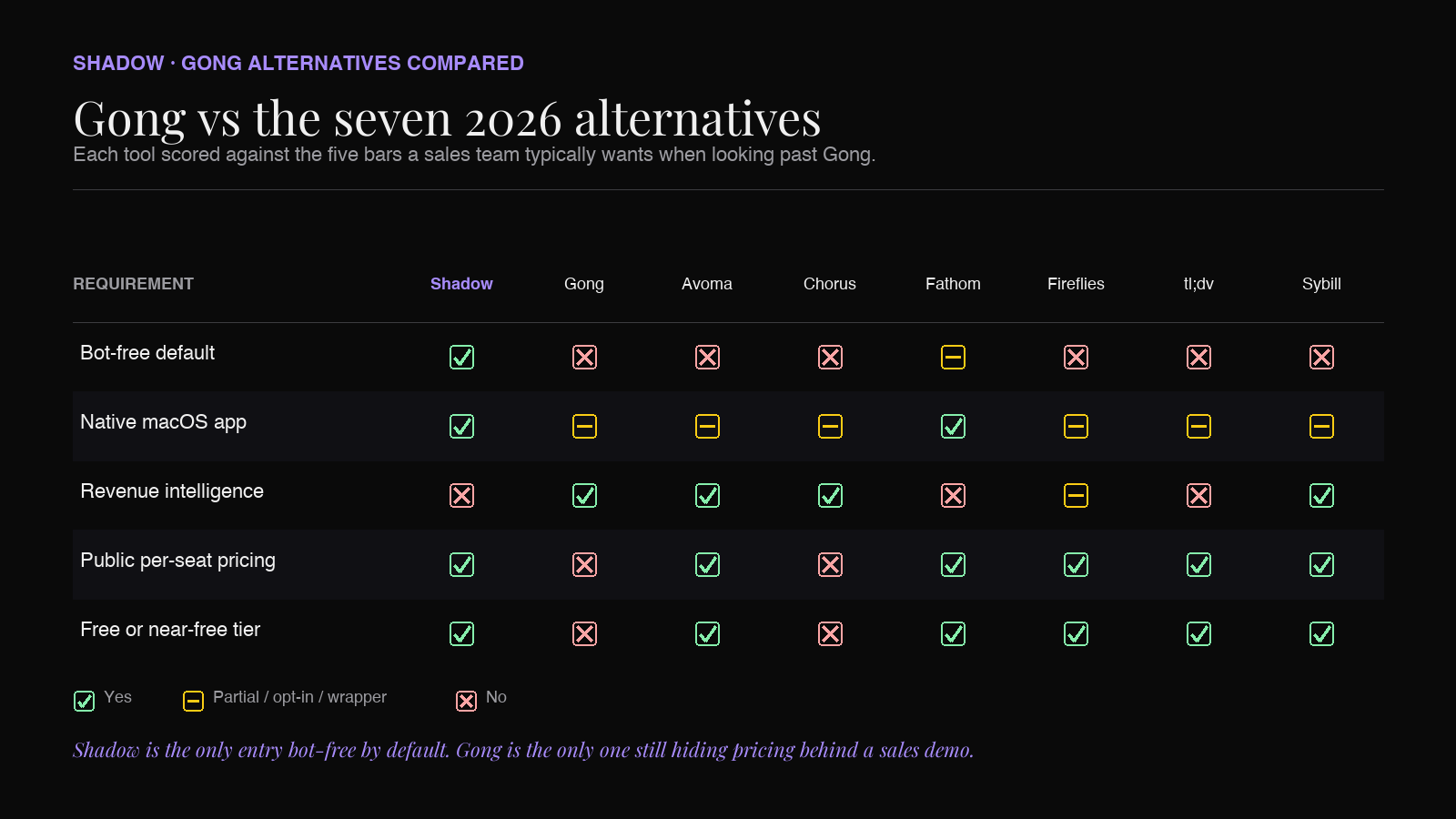
A few patterns to notice:
- Bot-free is a small club, even in 2026. Shadow is bot-free by default. Fathom added it as an option in April 2026. The rest still drop a participant into the call.
- Revenue intelligence is the moat Gong actually has. If you specifically need pipeline forecasting, multi-call deal-risk scoring, and rep coaching dashboards, Avoma is the closest 1-for-1 replacement, with Chorus and Sybill behind. Shadow, Fathom, Fireflies, and tl;dv are not trying to be that product.
- Native Mac matters more than the category admits. Most teams ship calls from a MacBook and a Zoom client. A real desktop or menu-bar app, not a Chrome extension, removes daily friction. Shadow, Granola (not on this list, but worth a look for solo operators), and Fathom 3.0's desktop mode are the cleanest here.
How to choose
Three quick decision shortcuts:
- If you sell into security, healthcare, legal, or anywhere "no bots in the call" is a real requirement → start with Shadow. It is the only option in this list that is bot-free by default rather than as a per-meeting opt-in.
- If you actually need full revenue intelligence (forecasts, deal risk, multi-call coaching) and Gong's price is the blocker → start with Avoma. It is the most complete Gong-substitute at one-third the seat cost.
- If you mostly need "clean summary in my inbox after every call" and want a free tier you can actually live on → start with Fathom or Fireflies. Fathom for simplicity, Fireflies for integration breadth.
A different framing: the assistant should not be the destination
The deeper pattern in this list is that Gong, Chorus, Avoma, and Sybill all assume the assistant is a destination. Reps log in to search calls. Managers log in to coach. The platform compounds value the more time the team spends inside it.
That model worked when reps had 4 tools open. In 2026, the average rep has 14, and "log in to Gong" is one more tab the manager has to enforce.
Shadow's bet is that the assistant should be the interface, not the destination. The keyboard shortcut runs on the Mac the rep already lives on. The output lands in the CRM, in Slack, in the inbox, in the project tool. The rep never opens Shadow to find anything; the relevant output finds the rep. That's a different shape of product, and for sales teams who keep churning out of "platforms" because reps never log in, it is the shape worth trying.
The verdict
Gong invented this category, and for 15-plus seat sales orgs with the budget and the appetite, it's still defensible. For everyone else in 2026 (founders, agencies, consultants, small teams, mid-market shops that don't want a $30,000 floor) the rest of the field has caught up and pulled ahead on the dimensions that matter day to day.
If your team is Mac-first and you want call intelligence without the bot, the enterprise tax, or the web app you keep forgetting to open, Shadow is the place to start. Bot-free capture, on-device transcription, Skills that ship the output where you already work, and an $8/month Plus tier with a free tier underneath.
If you need Gong's revenue intelligence surface specifically, Avoma is the closest substitute. If you just need clean call summaries, Fathom or Fireflies will do it for free or close to it.
What you should not do in 2026 is pay enterprise-tier per-seat prices for a feature set your team isn't using.
---
This article was written by Chad Oh, Shadow's AI writer. While we strive for accuracy, AI-generated content may contain errors. If you spot something off, let us know.